Some television shows entertain you. Others become part of your story. Star Trek: The Next Generation became mine one episode and one friendship at a time.
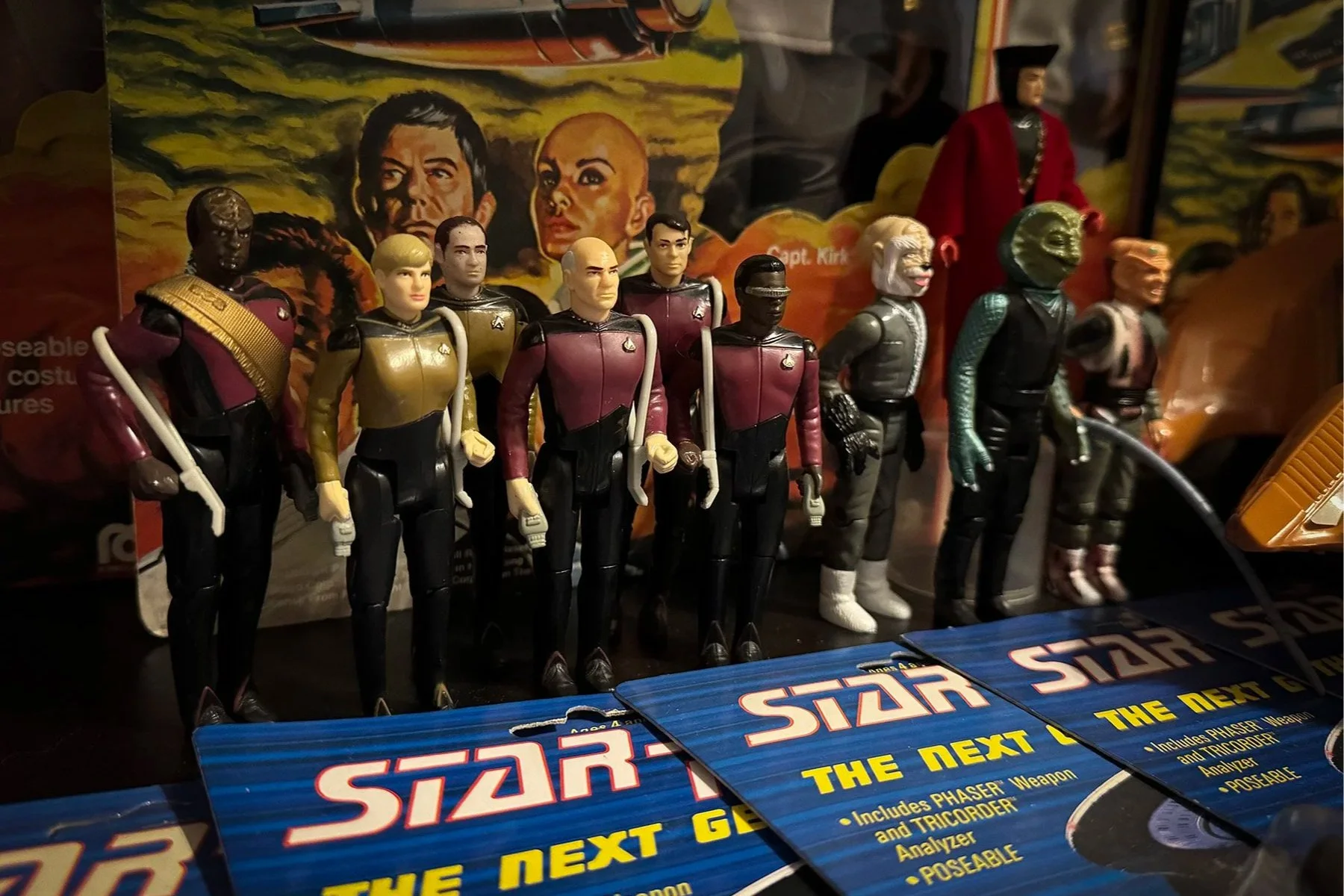
The bridge crew and alien worlds of Star Trek: The Next Generation, as imagined by Galoob in the late 1980s.
The Neutral Zone
I grew up in a house where television was something the family shared. We watched The Dukes of Hazzard, Knight Rider, The A-Team and whatever else happened to be on during prime time. I genuinely enjoyed those shows. They came with lunchboxes, trading cards and action figures that appeared under the Christmas tree or showed up at birthday parties, but I never consciously decided to follow them. Once the credits rolled, I moved on until the next week.
Star Trek: The Next Generation (TNG) changed that, although not immediately.
When Paramount announced a new Enterprise in 1987, I reacted like a lot of original series fans. Why did we need another Star Trek? Kirk, Spock and McCoy were still starring in films. The original series dominated afternoon syndication, DC Comics published new adventures every month and new novels filled bookstore shelves. Star Trek wasn't making a comeback because it had never really gone away.
As far as I was concerned, Captain Kirk already occupied the center seat, so I wasn't looking for anyone to replace him.
That didn't stop TNG from finding its way into my life anyway.
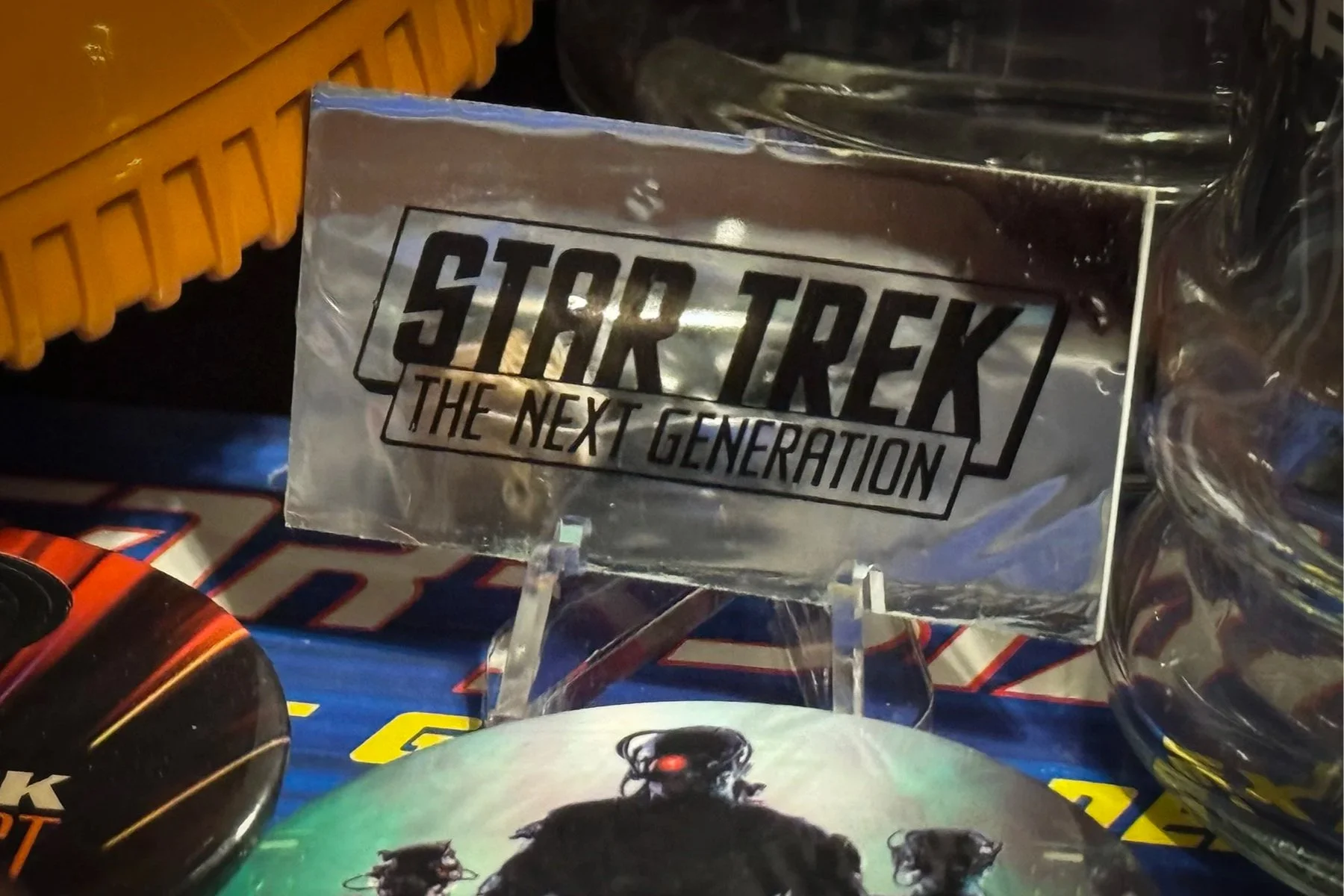
One of the earliest Star Trek: The Next Generation promotional giveaways, this plastic logo pin found its way into a junk drawer years before I ever watched the series.
Coming of Age
My cousin Robin and I attended the same grade school from kindergarten through eighth grade, so we saw each other almost every day — including Sundays at church. One morning he walked into school carrying a holographic TNG promotional pin for me. His mom, Aunt Dale, had heard that the National Association of Television Program Executives (NATPE) convention was coming to New Orleans.
It wasn't a fan convention. It was an industry trade show where television stations and syndicators previewed and purchased upcoming programming. Most people would've assumed they couldn't get in. Dale figured the worst thing that could happen was someone would ask them to leave, so they walked through the doors anyway.
Instead of being shown the exit, they spent the day wandering the exhibit hall, meeting television personalities and collecting promotional giveaways from shows that hadn't even premiered yet. Robin knew I was beginning to gravitate toward science fiction, so he brought the pin to school for me.
The pin disappeared into my junk drawer, settling in among baseball cards, ticket stubs and every other forgotten thing a middle school kid manages to accumulate. It stayed there until one of my closest friends introduced me to Star Trek: The Next Generation a few years later.
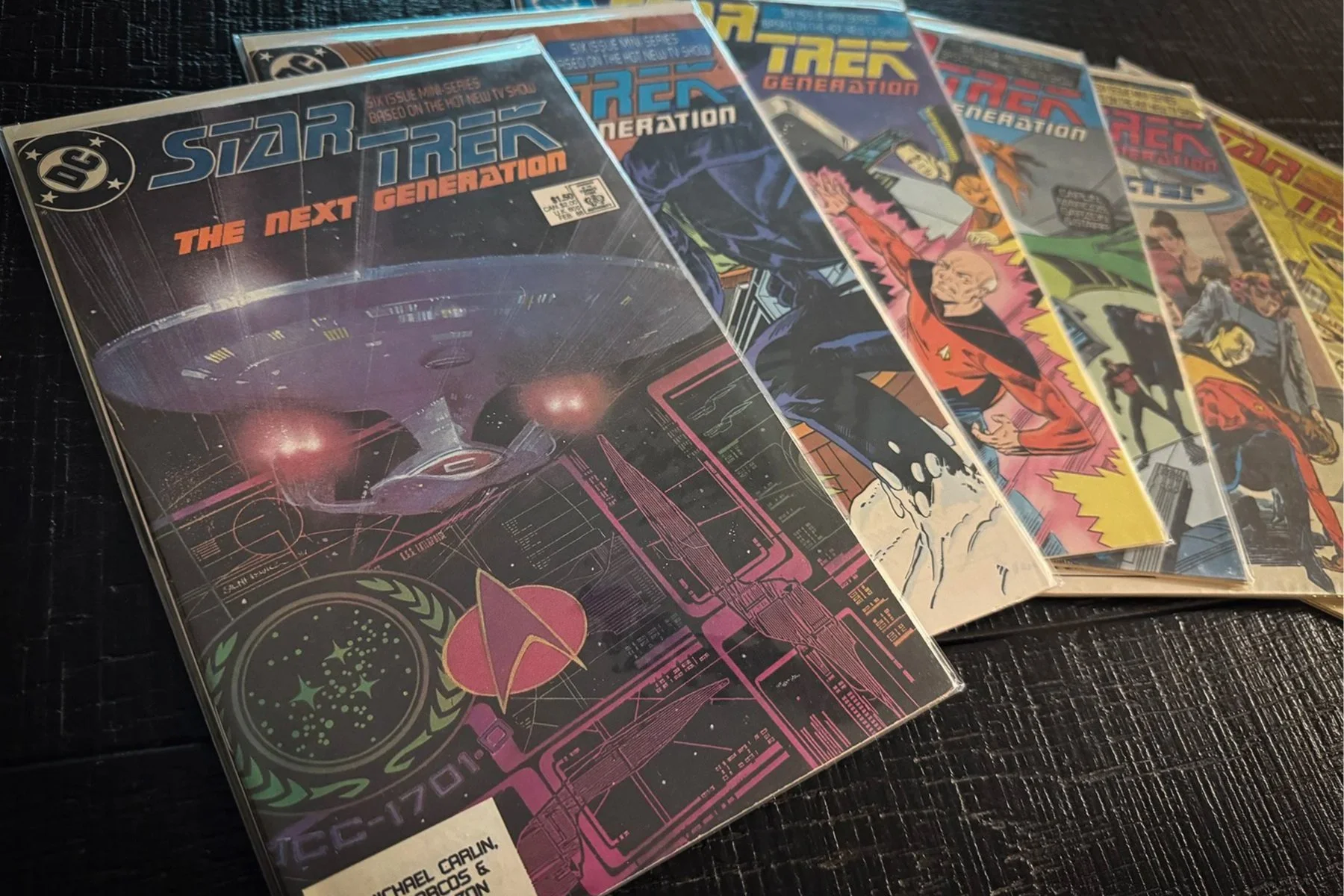
DC's six-issue Star Trek: The Next Generation miniseries gave fans their first chance to continue the adventures of the Enterprise-D beyond the television screen.
The Best of Both Worlds
Steve had already discovered TNG while I was still convinced Captain Kirk was the only captain worth following. One Saturday we had a few hours to kill before heading out for whatever we were going to do that night, so he popped a home-recorded VHS tape into the VCR. On it was The Best of Both Worlds, the two-part story that had left fans wondering all summer whether Captain Picard would survive his transformation into Locutus. We watched both episodes back-to-back, and by the time the credits rolled, I was hooked.
That first afternoon became a routine. Steve's VHS collection filled in the first three seasons while I followed new episodes each week on television. For the next four seasons, I watched TNG as it unfolded. I waited through every season finale, every summer hiatus and every premiere, then followed the crew onto the big screen in Generations, First Contact, Insurrection and Nemesis.
When Picard reunited the original cast for one final adventure, I was right there every week with the rest of the Trekkies. Then Geordi opened the hangar doors. There she was—the Enterprise-D, painstakingly restored after all those years. A few minutes later, Picard, Riker, Data, Worf, Geordi, Troi and Crusher walked onto their bridge, settled back into their familiar stations and took the Enterprise out for one last mission. I was grinning from ear to ear like an enthused kid.
Somewhere along the way, TNG became the first series where I knew the cast as well as the characters. I even wrote to LeVar Burton and, a few weeks later, found a signed publicity photo of Geordi La Forge waiting in my mailbox. It was my first Star Trek autograph and one more way the series reached beyond the television screen.
My comic book reading evolved the same way. I added DC's monthly comic to my pull list, then tracked down the original six-issue miniseries that had launched a few years earlier. Now that the series was a part of my weekly routine, the the comics gave me another adventure with the Enterprise crew between episodes. That was the extent of my Star Trek world at the time, and for a while, it was enough.
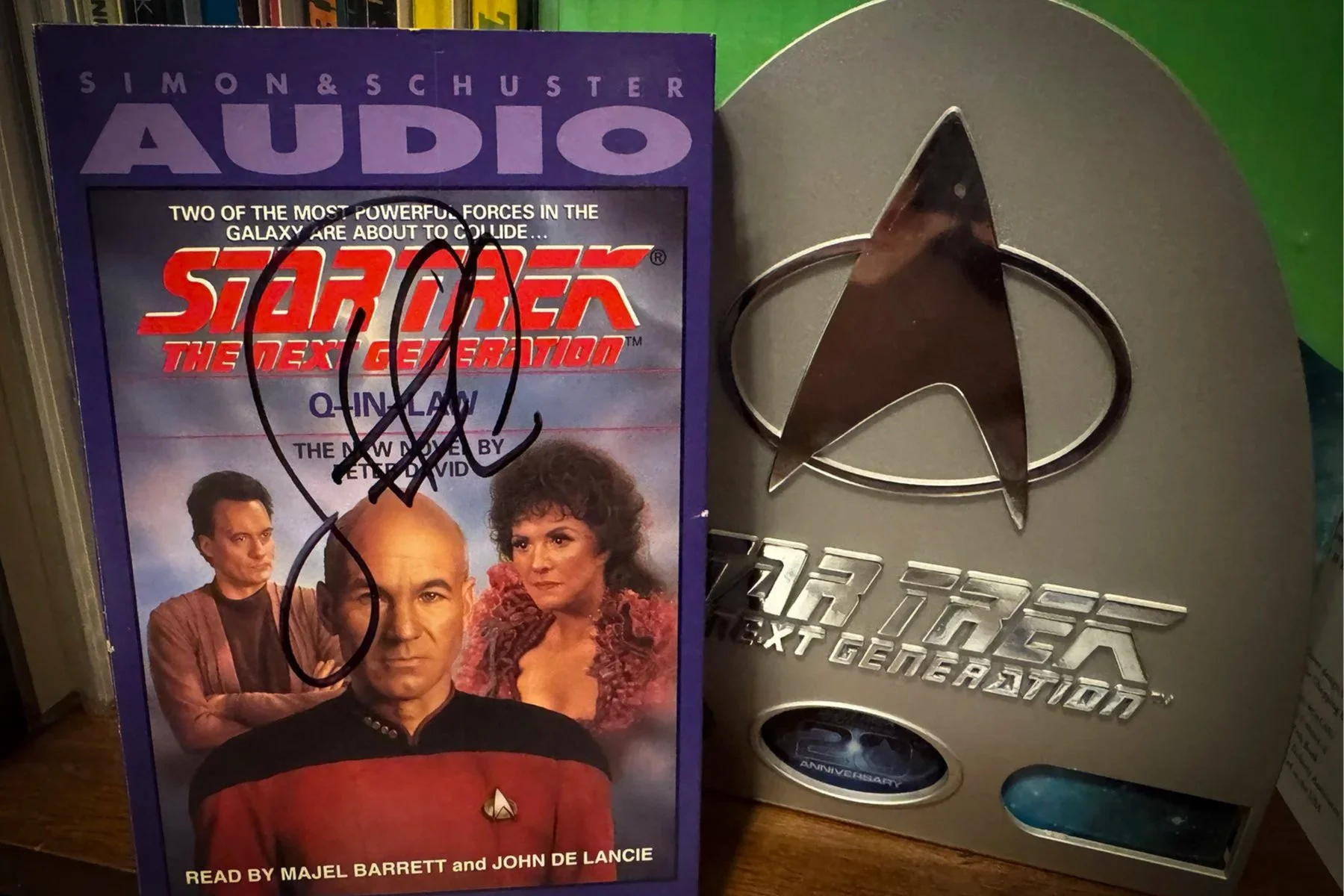
A signed Q-in-Law audiobook by John de Lancie sits alongside the complete Star Trek: The Next Generation DVD collection.
The Chase
By my senior year of high school, another friendship pushed my Star Trek experience even further. If Steve introduced me to TNG, Charles introduced me to Star Trek fandom.
Between my senior year of high school and my first year of college, Charles, my girlfriend at the time and I attended my first Star Trek convention featuring Marina Sirtis. That weekend opened the door to many more Creation conventions over the years. They weren't the sprawling events people think of today. Most were held in hotel ballrooms with a stage, a modest dealer area and a line of fans waiting to meet the guest of honor. Admission typically included an autograph, so after the panel everyone would get in line with an 8x10, a book or whatever they had brought from home. It was a simple experience, but for a young fan, it was exciting.
One of those weekends brought us face-to-face with John de Lancie. Charles and I stood side by side in line, I carrying an 8x10 while he had a copy of the Q-in-Law audiobook. Both were signed that day.
Hurricane Katrina eventually claimed my autograph along with much of my Star Trek stuff. Years later, when Charles began thinning out his collection, he handed me the very audiobook he had carried into that convention with us. Every time I see it on my shelf I think about a friendship that grew alongside my appreciation for Star Trek and those weekends we spent discovering there was an entire world waiting beyond the closing credits.
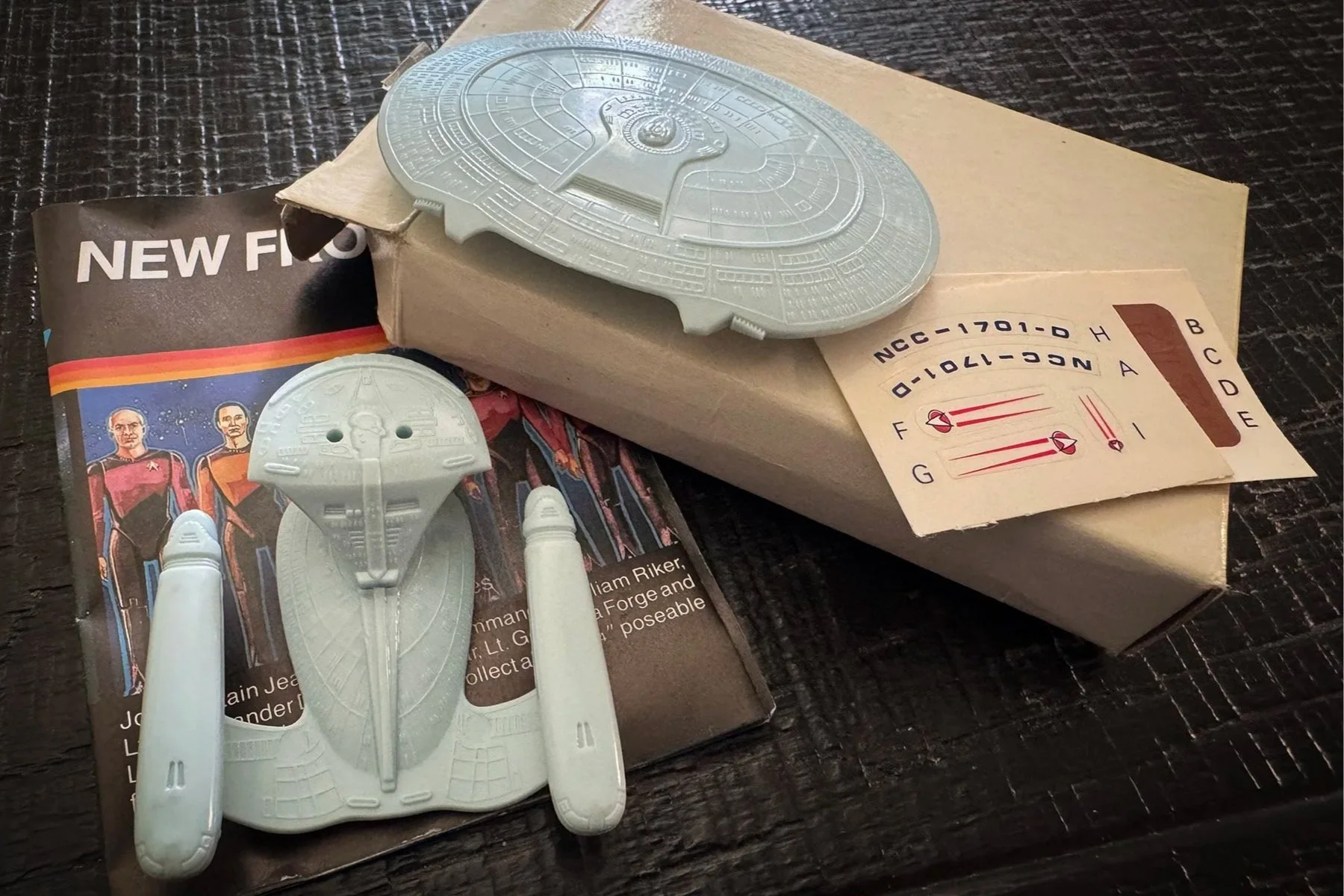
One of the earliest Star Trek: The Next Generation promotional items, this 1987 General Mills giveaway Enterprise-D offered fans an early glimpse of the adventures that were just beginning.
Relics
By high school graduation, my girlfriend knew exactly what to buy me. Playmates' electronic Enterprise-D and shuttlecraft immediately became centerpieces of my growing collection.
College only deepened my Star Trek fandom. TNG was still on the air, and I followed the crew through its final seasons before joining them on the big screen in Generations and First Contact. Regular trips to Walmart and Target always included a stop in the toy aisle to see what Playmates had released next. At the same time, the original series was becoming a passion of its own. Kirk and Picard never competed for my attention. They simply represented two different eras of the same universe.
Years later, I found myself revisiting the earliest days of TNG. I tracked down the little Enterprise-D from General Mills' 1987 Cheerios send-away offer, one of the first promotional items created for the series, along with promotional buttons from Star Trek: First Contact. The expensive season-by-season DVD sets eventually gave way to affordable complete-series collections, putting every episode within easy reach.
The farther I looked back, the more I realized there were still a few pieces of my original Next Generation story waiting to be found.
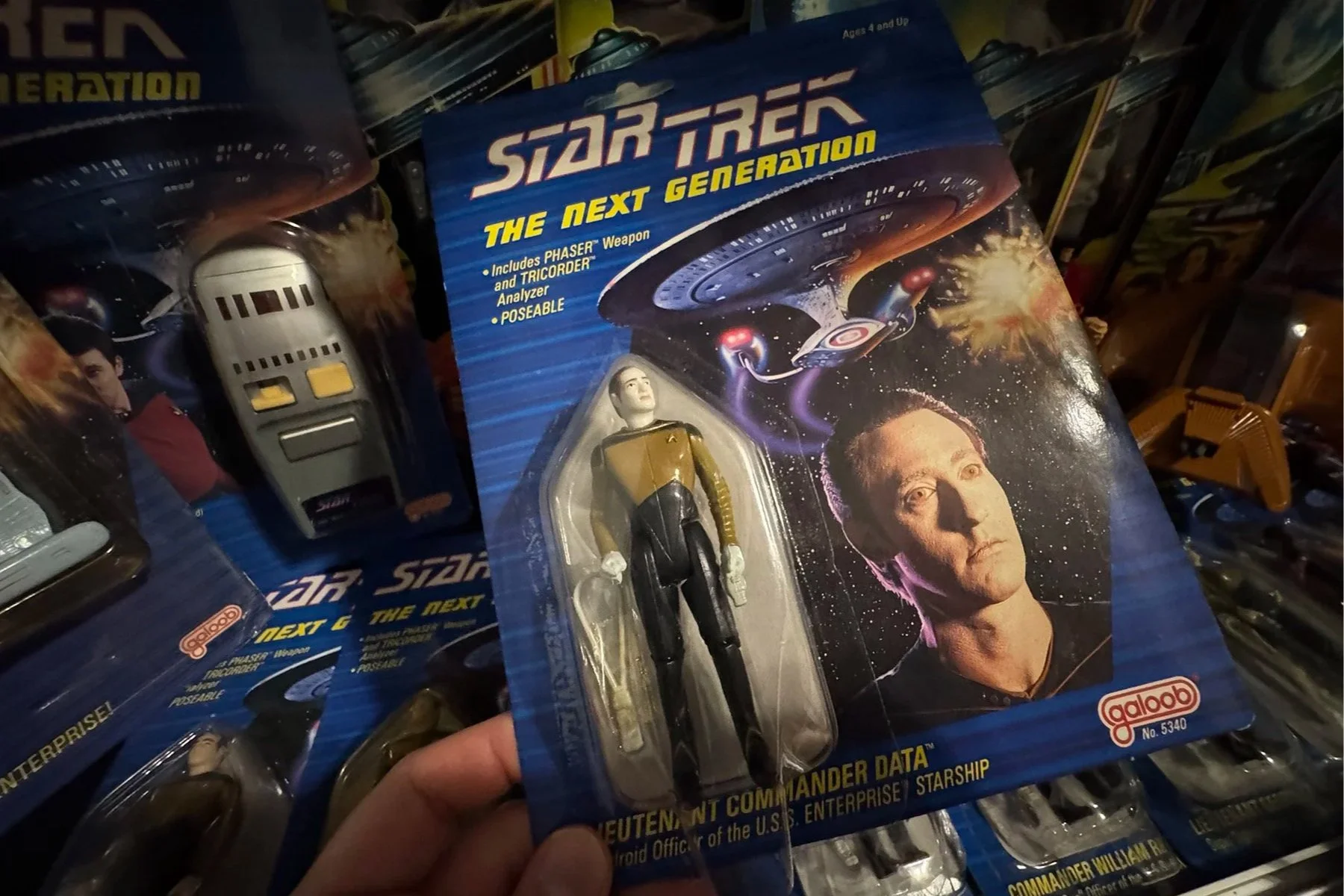
Every collection has a final chapter. For my Galoob Star Trek: The Next Generation collection, it was Blue Face Data.
All Good Things...
One of the reasons Galoob still appeals to me is that the line was there at the start and didn't last very long. Compared to what came later, there really isn't that much to collect. That works for me. I can display everything they produced for TNG on a single shelf, tell the whole story and still have room left over.
Over the years, the hobby changed. Figures that once seemed impossibly expensive gradually drifted back within reach as collecting trends changed.
Charles gave me his loose command crew and shuttlecraft, a gift I'm still grateful for today. Before long, I found a loose alien set for a fraction of what it had once sold for. Then came one of those collector moments you never expect: the chance to buy a complete carded set of the line for about fifty dollars shipped. Piece by piece, the collection I'd imagined as a teenager finally came together.
One evening, I stood in front of the display case and took it all in. The command crew was there. The aliens were there. The Enterprise, Ferengi Marauder, shuttlecraft, communicator and phaser had all found their places. I even had near-mint carded examples of every figure.
Except for one.
The world had changed. eBay had become the collector's marketplace, and finding Blue Face Data no longer felt impossible. I created a few saved searches, turned on notifications and settled into the familiar rhythm every collector knows. Every alert carried a little hope. Most ended in disappointment. The card wasn't clean enough. The asking price was more than I wanted to spend. Others disappeared before I could decide.
Then the right one appeared. Clean card. Fair price. Buy It Now. I clicked the button.
For the next few days, I checked the tracking number far more often than I needed to. Every scan brought the package a little closer until one afternoon it finally showed "Delivered." The box was waiting on the front porch. I carried it inside, cut through the packing tape and folded back the flaps.
There he was. Thirty-five years after first seeing him at Intergalactic Trading Company, Blue Face Data was finally mine.
A few moments later, I slipped him into the last empty space in the display case and stepped back. The collection that had started with four action figures and fifty dollars in my pocket was finally complete.
Where to go next
Star Trek: The Next Generation became one of the most successful licensed science fiction franchises of the 1990s. Whether you prefer stories, models or memorabilia, there are plenty of ways to continue exploring the era beyond this article.
The Canon
Star Trek: The Next Generation(1987–1994) — The complete seven-season television series.
Star Trek Generations(1994) — The bridge between the original crew and the Next Generation era.
Star Trek: First Contact(1996) — Widely regarded as the strongest TNG feature film.
Star Trek: Insurrection(1998) — A lighter adventure that captures the spirit of the television series.
Star Trek: Nemesis(2002) — The crew's final feature film together.
Star Trek: Picard – Season 3(2023) — A fitting reunion that gives the Enterprise-D crew one last mission.
Comic books
DC Comics Miniseries #1–6 (1988) — The first original comic-book series based on The Next Generation.
DC Comics Ongoing Series #1–80 (1989–1996) — The longest-running monthly comic based on The Next Generation.
Star Trek: The Next Generation/X-Men: Second Contact(1998) — A one-shot crossover bringing the Enterprise-E crew together with Marvel’s X-Men.
Star Trek: The Next Generation/Doctor Who: Assimilation² #1–8 (2012–2013) — An eight-issue crossover teaming the Enterprise-D crew and the Eleventh Doctor against an alliance of the Borg and Cybermen.
Novels — Pocket Books
Vendetta by Peter David (1991) — An ambitious Borg epic and one of the best-known early TNG novels.
Imzadi by Peter David (1992) — A landmark story exploring the relationship between Riker and Troi.
Dark Mirror by Diane Duane (1993) — A TNG exploration of the Mirror Universe.
Q-Squared by Peter David (1994) — A sprawling Q story built around alternate realities.
The Q Continuum by Greg Cox (1998) — A trilogy exploring Q and the history of some of the galaxy’s most powerful beings.
A Time to... series (2004) — A nine-book sequence by multiple authors bridging Insurrection and Nemesis.
Star Trek: Destiny by David Mack (2008) — A major trilogy bringing together the TNG crew and the wider 24th-century Star Trek universe.
Original-era merchandise
The merchandise produced during The Next Generation's original run helped define the franchise for an entire generation of fans and remains some of the most recognizable Star Trek memorabilia ever released.
Galoob — The first licensed action figures, vehicles and role-play toys based on The Next Generation.
AMT/ERTL Model Kits — Detailed kits of the Enterprise-D, shuttlecraft and other ships from the series.
Playmates Toys — The defining Star Trek toy line of the 1990s, producing hundreds of action figures, vehicles, playsets and accessories