Five comic books became the starting point for an hour-long conversation with Jim Shooter about publishing, storytelling and building a universe.

Jim Shooter speaks during a panel discussion at Showcase Comic Con in Slidell, Louisiana. The longtime Marvel Editor-in-Chief and Valiant founder shared stories from a career that helped shape modern comics.
Showcase Comic Con
Every comic convention creates its own opportunities.
Some bring together hundreds of artists, writers, actors and vendors, making it almost impossible to see everything in a single weekend. Others are built around a smaller guest list, giving fans the chance to spend more time exploring dealer tables, connecting with friends and, if the timing is right, having conversations that unfold on their own.
Showcase Comic Con in Slidell was one of those shows.
On June 25, 2022, Jim Shooter was the guest I had come to meet. His appearance had originally been scheduled the previous year before COVID forced the event to be postponed, giving me plenty of time to decide which books I wanted him to sign. For me, that's never a last-minute decision. Every book has a reason for being in the stack before I ever ask someone to pick up a pen. By the time I reached Jim Shooter's table, I had settled on five comics.
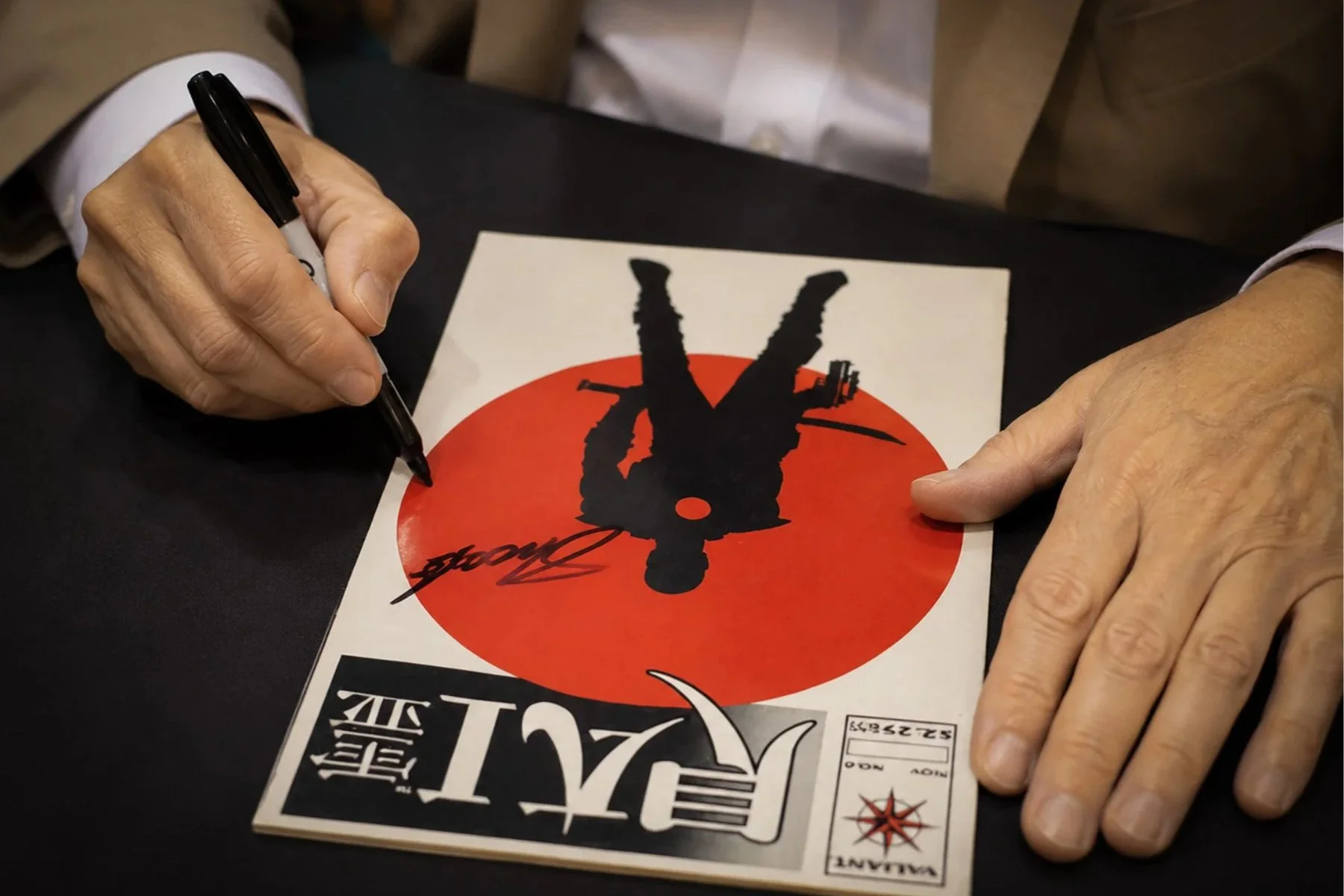
Jim Shooter signs Rai #0 during Showcase Comic Con in Slidell, Louisiana. The issue became one of five carefully chosen comics that captured different chapters of his career and the conversation that followed.
Five comics
At the top of the stack sat Secret Wars #8.
That choice was easy. Several years earlier I had met Mike Zeck, whose artwork defined the twelve-issue series, and he signed the same copy. Jim Shooter's signature completed the creative partnership behind one of Marvel's most influential stories. What began as a crossover tied to Mattel's toy line became Marvel's first company-wide event, introducing Spider-Man's black costume and laying the foundation for Venom. It also produced one of my favorite comic book covers, making it an easy choice for the stack.
The Valiant books followed the same philosophy.
I had already met Bob Layton at an earlier convention, so bringing Rai #1 and the Magnus Robot Fighter #5/Rai flipbook gave me the opportunity to pair Shooter's signature with another creator who helped shape the Valiant Universe. The flipbook introduced Rai, Valiant's first original superhero, while Rai #1 gave that character his first ongoing series. Together, they represented the moment Valiant stopped simply reinventing licensed Gold Key characters and confidently began building heroes of its own.
Solar: Man of the Atom #1 completed what I think of as the foundation of early Valiant. Although Magnus Robot Fighter launched the line, Solar quickly became one of the central titles around which the universe was built. Barry Windsor-Smith's cover is reason enough to own the book, but it also represents Jim Shooter's determination to prove there was room in the market for another shared superhero universe built on long-term planning instead of shortcuts.
The final book, Rai #0, earned its place for several reasons. It became one of the defining issues of early Valiant, expanding the publisher's future mythology while featuring Bloodshot's first full appearance. The cover has always been one of my favorites (and a personal hoard book), pairing a bold black silhouette against an oversized red sun in one of the publisher's most recognizable images.
...Yes, it's a swipe.
Jim Shooter said so himself. He borrowed the pose from a Mike Zeck Punisher illustration before David Lapham completed the published cover. Fortunately, great comic book covers are judged by more than their point of origin, and Rai #0 remains one of the defining images of the early Valiant era.
Every book arrived at Jim Shooter's table with a purpose. Together, they celebrated the Marvel years that first introduced me to his work, the Valiant years that made me follow it intentionally and the creative partnerships that brought both chapters to life. Before we exchanged a single word, those five comics had already explained why I was there.
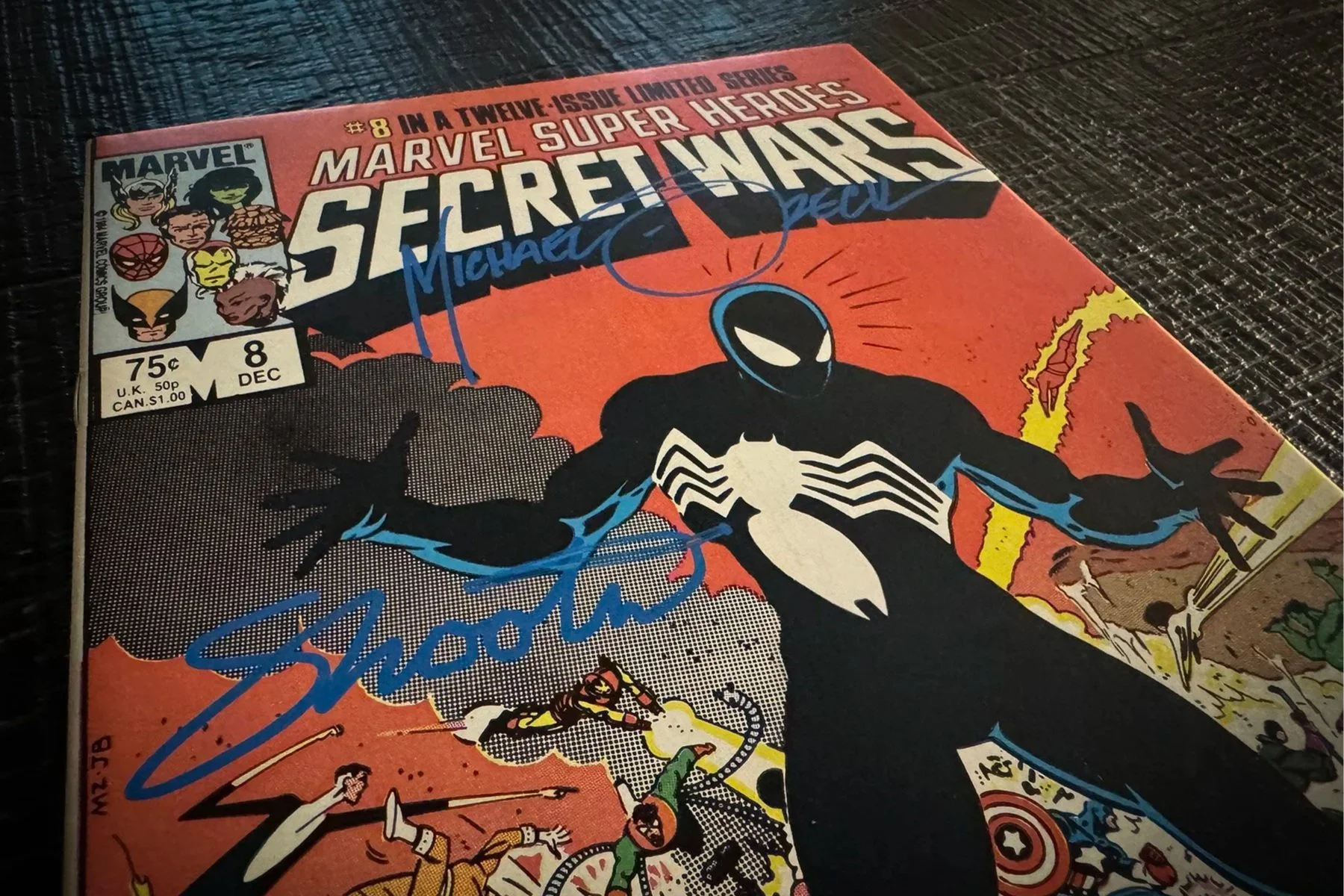
Secret Wars #8 features the signatures of writer Jim Shooter and artist Mike Zeck, reuniting the creative team behind one of Marvel's most influential stories and the comic that introduced Spider-Man's black costume.
The names in the credits
Like most young readers buying comics off the convenience store spinner rack, I gave the opening splash page about three seconds before moving on to the story. Spider-Man, Batman and Superman were the reason I kept coming back every month. The names in the credits simply weren't on my radar yet.
But by the time I became an avid reader, the people behind the books I read started to gain more and more importance to me. That became especially true with Valiant. I wasn't discovering a universe that already had decades of history behind it. I was watching one being built in real time. Every new title expanded the world. Every issue felt connected to the last, rewarding readers who stayed with the line month after month. It was a publisher built on continuity, long-term planning and the idea that every series belonged to something larger.
At the back of many of those books was a face and a name I was beginning to recognize almost as much as the Valiant heroes themselves: Jim Shooter. Sometimes I read every editorial. Sometimes I turned the page and grabbed the next comic. Either way, I knew whose universe I was reading.
During Valiant's heyday, that connection carried far more weight for me than any Stan Lee voiceover introducing a Saturday morning cartoon.
That isn't a comparison of accomplishments. Stan Lee represented the Marvel Universe I inherited. Jim Shooter represented the Valiant Universe I experienced from the very beginning. As Editor-in-Chief, he gave readers something they didn't often see: a direct line to the person guiding the publisher's creative vision.
When Unity arrived in 1992, following every Valiant title suddenly paid off. Characters, storylines and seemingly small moments came together in ways that felt exciting and intentional. Every issue rewarded readers who had stayed with the line, making Unity feel less like an event and more like the destination the entire universe had been building toward.
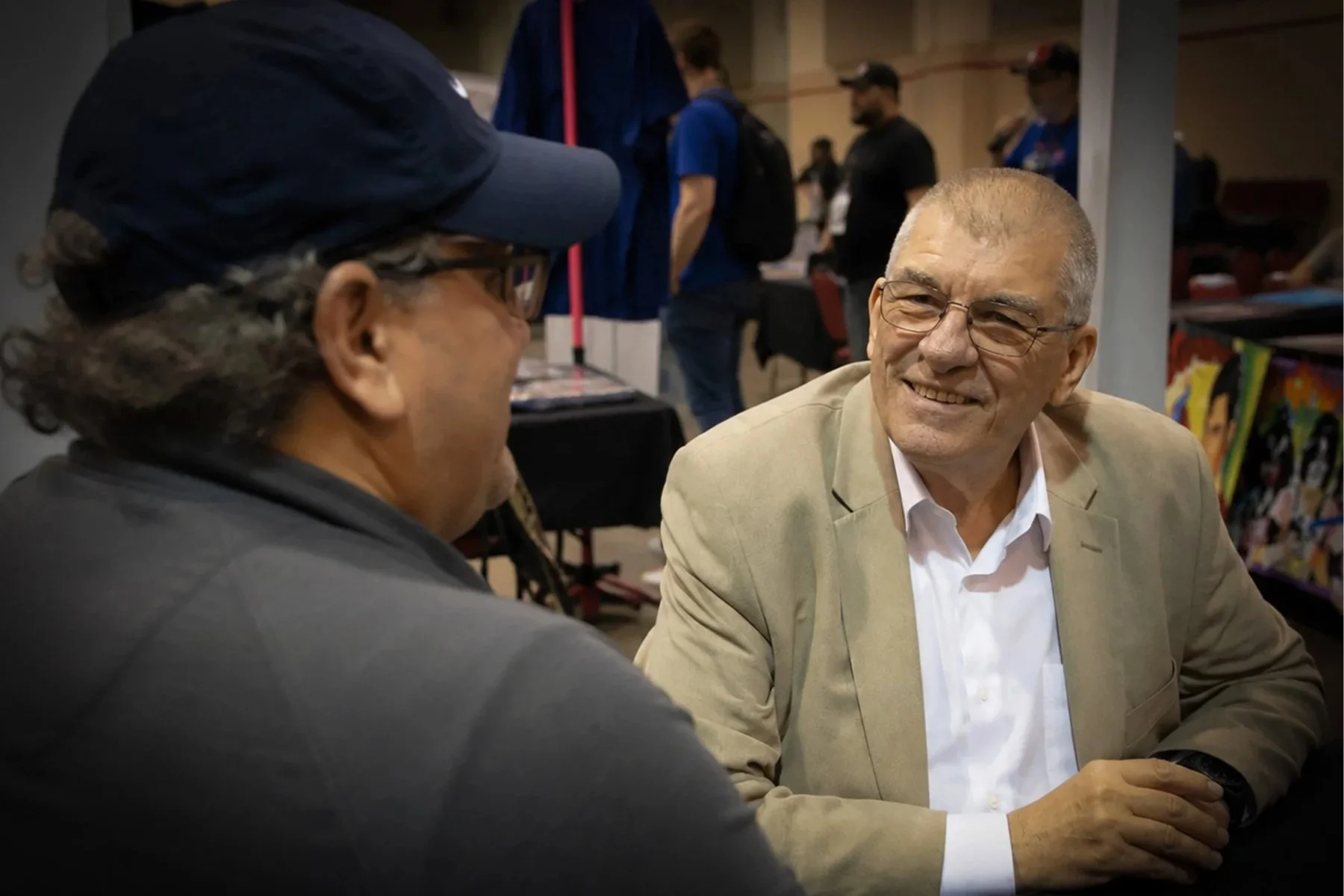
Tim San Fillippo and Jim Shooter talk during Showcase Comic Con. What began as a simple autograph request turned into an hour-long conversation about comics, publishing, entrepreneurship and the creative process.
Meting the legend
When I introduced myself, I expected exactly what every collector hopes for—a smile, a handshake and a few signatures.
The convention floor had only recently opened, there wasn't much of a line yet and we simply kept talking. We covered Marvel, Valiant, publishing, entrepreneurship and the realities of building a comic book company. Along the way, Jim shared stories gathered across decades in the industry, reflecting on creators, editorial decisions and the challenge of building something that lasts. I wish I had recorded every minute because it remains one of the most enjoyable conversations I've ever had with a creator.
As we talked, fans continued walking up to the table. Jim welcomed every person warmly, signed their comics, exchanged a few words and sent them on to enjoy the rest of the show. Then he picked our discussion right back up without ever losing his train of thought.
That rhythm continued for nearly an hour. By the end, it probably looked as though I had come to the convention with him. Maybe people assumed I was helping at the table. Maybe they simply respected what was already taking place. Either way, no one interrupted us, and Jim never suggested our time together should come to an end.
I still don't know why Jim chose to spend that much time with me. Perhaps I was asking questions that took us beyond the comics themselves. Perhaps we connected over publishing, creativity and entrepreneurship. Perhaps that's simply who Jim Shooter was. I never found the answer, and I've never really needed one. I simply appreciated the gift of his complete, undivided attention.
By the time I gathered my books, the signatures had become reminders of an hour spent across the table from another person, enjoying an unhurried conversation simply because we were both glad to be having it.
I've been fortunate to meet Stan Lee, Neal Adams, George Pérez, Marv Wolfman, Mike Zeck and many other creators over the years, and every one of those encounters has its own story. Jim Shooter's generosity gave me one I'll always appreciate.
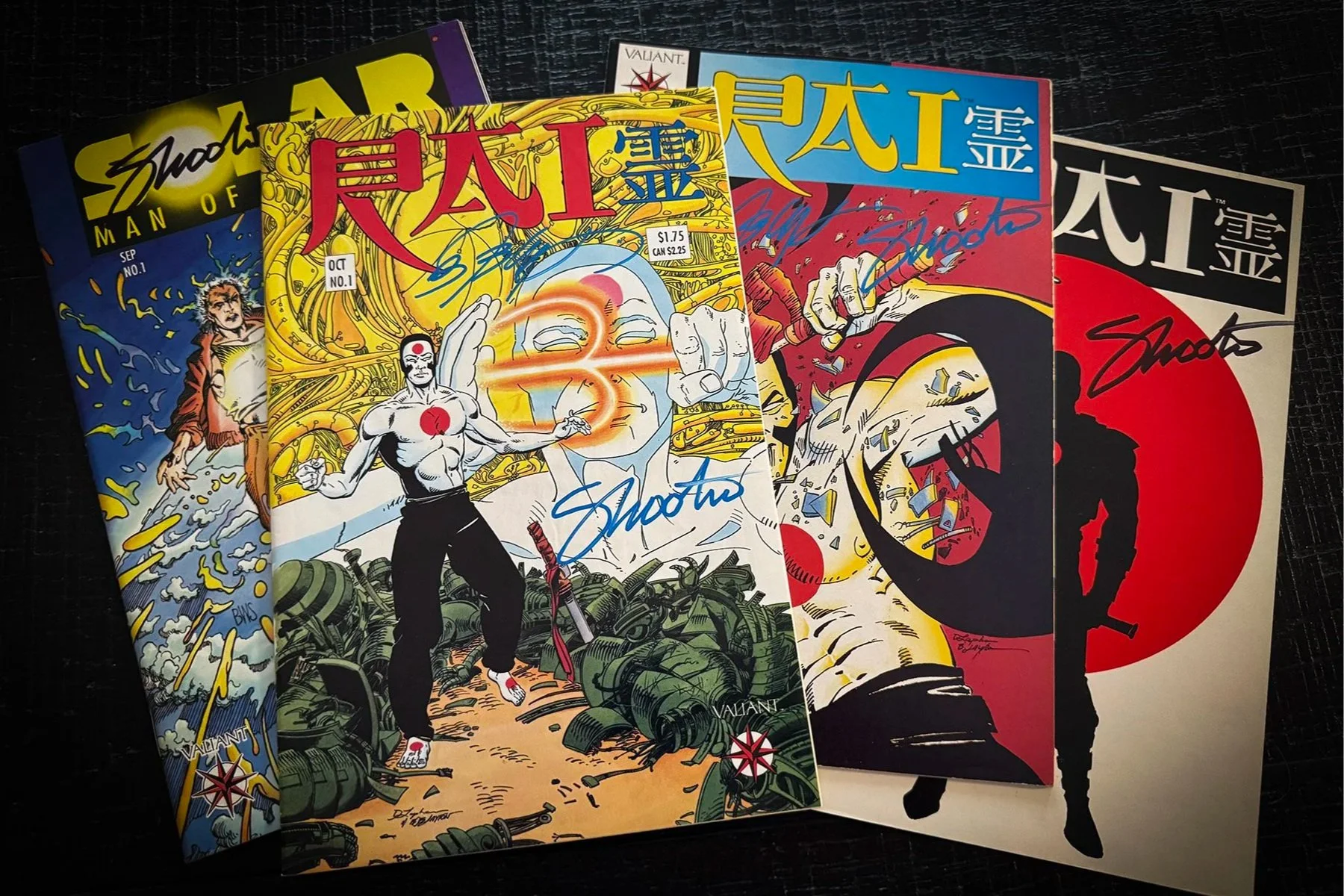
Four of the five comics I brought to Jim Shooter pictured: Solar, Man of the Atom #1, Rai #1, Rai #0 and the Magnus Robot Fighter #5/Rai flipbook. Together, they represent the early Valiant Universe that first taught me to follow the names in the credits as closely as the heroes on the cover.
When the news broke
Jim Shooter passed away on June 30, 2025, after a battle with esophageal cancer. He was seventy-three years old.
The tributes that followed celebrated his years as Marvel's Editor-in-Chief, Secret Wars, the rise of Valiant and the lasting influence he had on modern comics. Some remembered him as a demanding editor. Others remembered him as an ambitious publisher, a gifted storyteller or an entrepreneur who never stopped building. Whether readers agreed with every decision he made or not, few questioned the impact he had on the comic book industry.
When I think about Jim Shooter, my mind always returns to Showcase Comic Con. I see a creator who welcomed every fan with a smile, signed every book with care and somehow found nearly an hour to sit across a table from one collector and talk about comics, publishing, business and creativity. I think about the editorials that taught me to notice the names in the credits, the publisher that showed me how a shared universe could be built with intention and the generosity he extended to someone he had only just met.
Those five comics eventually found their way back to the long boxes where they belong. Secret Wars #8 returned to Marvel. Solar, the Magnus Robot Fighter #5/Rai flipbook and the Rai books went back to Valiant. Every so often, while pulling a comic for an entirely different reason, one of Jim Shooter's signatures catches my eye. The memory follows almost immediately, carrying me back to a Saturday morning in Slidell and an hour of genuine conversation with one of the most influential figures the comic book industry has ever known.
For me, that's Jim Shooter's legacy. It's found in the stories he wrote, the creators he encouraged, the universes he helped build and the generosity he showed a reader who walked up to his table carrying five carefully chosen comic books. I couldn't ask for a better way to remember him.

Where to go next
Jim Shooter's career spanned more than six decades as a writer, editor, editor-in-chief, publisher and entrepreneur. Rather than trying to read everything, I'd recommend starting with the books and publishers that best represent the major chapters of his career. Together, they tell the story of one of comics' most influential creative voices.
DC Comics
Adventure Comics / Superboy: Legion of Super-Heroes(1966–1977) — Shooter began writing Legion stories at just fourteen years old, launching one of the most remarkable careers in comic book history.
Marvel Comics
The Avengers #161–211(1977–1981) — Shooter's defining run as a writer, collaborating with artists including George Pérez and John Byrne.
Marvel Super Heroes Secret Wars #1–12(1984–1985) — Marvel's first company-wide crossover introduced Spider-Man's black costume and forever changed the way publishers approached event comics.
Valiant Comics — The Jim Shooter Era (1991–1992)
Shooter's editorial vision extended well beyond the books he personally wrote. Through editorials that appeared throughout the line and an unwavering commitment to continuity, these titles represent the Valiant Universe as it developed under his leadership.
Magnus, Robot Fighter #1–20 — The series that launched the Valiant Universe.
Solar, Man of the Atom #1–15 — One of the central pillars of early Valiant.
Harbinger #1–10 — Introduced one of Valiant's most successful original concepts.
X-O Manowar #0–7 — Expanded the universe with one of Valiant's signature heroes.
Archer & Armstrong #0–8 — Added mythology, history and humor to the growing line.
Shadowman #0–8 — Introduced the supernatural corner of the Valiant Universe.
Rai(Magnus #5–8 flipbook, Rai #0–4) — Introduced Valiant's first original superhero while expanding the publisher's future timeline.
Unity #0–1 — Shooter's bookend issues to Valiant's landmark eighteen-chapter crossover.
The titles above naturally build toward Unity, Valiant's landmark crossover where nearly every major storyline and character introduced during Shooter's tenure converges into one of comics' most rewarding shared-universe events.
Defiant, Broadway and Acclaim (1993–2000)
Defiant Comics(1993–1995) — Shooter's next attempt to build an original shared superhero universe.
Broadway Comics(1995–1996) — Another creator-owned publishing venture built around new characters and ideas.
Unity 2000 #1–3(1999–2000) — An ambitious but unfinished attempt to reconcile the original Valiant and Acclaim universes.
The Dark Horse Revival (2010–2011)
Doctor Solar, Man of the Atom / Magnus, Robot Fighter (Free Comic Book Day 2010) — All-new stories introducing Shooter’s Dark Horse revival of the Gold Key heroes.
Doctor Solar, Man of the Atom #1–8(Dark Horse Comics, 2010–2011) — Shooter returned to one of the characters most closely associated with his career during Dark Horse's revival of the Gold Key heroes.
Magnus, Robot Fighter #1–4(Dark Horse Comics, 2010–2011) — A return to the character who had helped launch the Valiant Universe nearly twenty years earlier.
Turok, Son of Stone #1–4(Dark Horse Comics, 2010–2011) — Shooter revisited another Gold Key character that had become part of the Valiant Universe.
Mighty Samson #1–4(Dark Horse Comics, 2010–2011) — Completed Shooter's four-title return to the classic Gold Key adventure heroes