Before Oz found a new generation through bestselling novels, Broadway and Hollywood, one ‘90s independent comic publisher built a gritty fantasy epic that deserves another look.
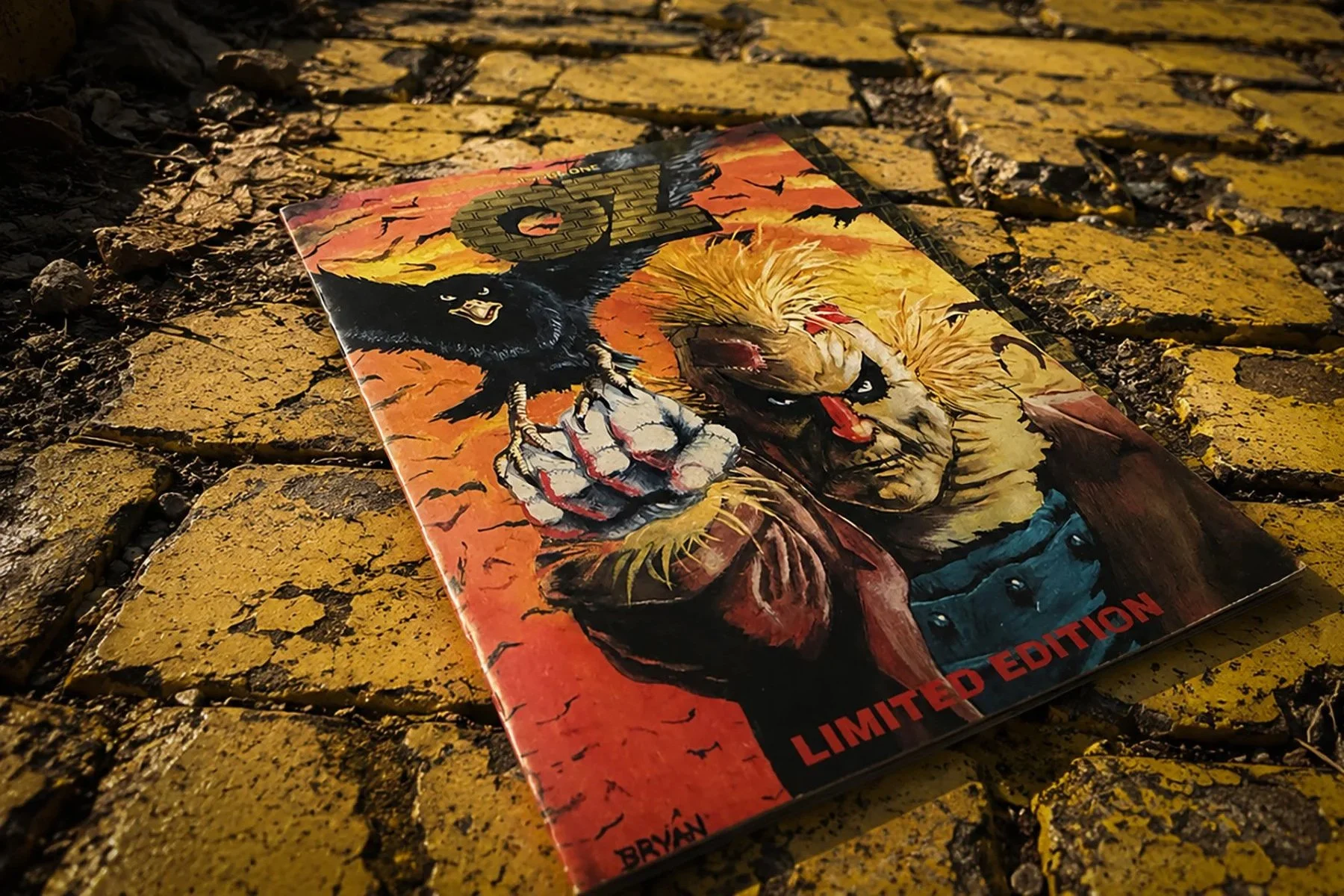
Signed limited edition of OZ #1 from Caliber Comics photographed on a weathered Yellow Brick Road, symbolizing the beginning of the publisher's dark reinterpretation of L. Frank Baum's Oz.
Down the yellow Brick Road
Lunch during my years at the University of New Orleans often meant getting away from campus for an hour or two. If my schedule allowed it, I'd drive down Elysian Fields, grab lunch at Lee's or Bud's Broiler, then make my way over to Crescent City Comics.
This wasn't the shop that handled my weekly pull list. In some ways, that made it even better. My local comic shop in Chalmette was a fine place for new comics, but at its heart it was a baseball card store that had expanded into the hobby. If you didn't order a book, there was a good chance you weren't going to find it sitting on the shelf.
Crescent City Comics was a comic shop in every sense of the word. Graphic novels filled the bookcases. Medium- and high-priced key issues lined the walls. Independent publishers shared shelf space with Marvel and DC, while manga and Japanese imports appeared long before they became commonplace. It was also the first place I ever saw an authentic copy of Amazing Fantasy #15. More importantly, it stocked books beyond what customers ordered through their monthly pull lists. It was the kind of store where discoveries happened.
One afternoon in 1995, while wandering the shelves before heading back to class, one of those discoveries stopped me in my tracks: a trade paperback titled OZ: Mayhem in Munchkinland.
The cover immediately grabbed my attention. The Scarecrow, Tin Woodman and Cowardly Lion were all there, but they looked nothing like the companions I remembered from childhood. The Tin Woodman gripped his axe with obvious menace. The Lion looked capable of tearing someone apart. Even the title suggested that something had gone terribly wrong beyond the Emerald City.
A few pages into the book, I realized I had found far more than another adaptation of The Wizard of Oz. Stuart Kerr, Ralph Griffith and Bill Bryan had opened the door to an entirely different corner of Baum's universe, one shaped by war, betrayal and a mythology that stretched well beyond Dorothy's journey down the Yellow Brick Road. I had to have it.
Caliber's OZ became one of my favorite independent comic series of the 1990s, introducing me to a darker, richer interpretation of Baum's world and setting me on a path I never expected to follow.
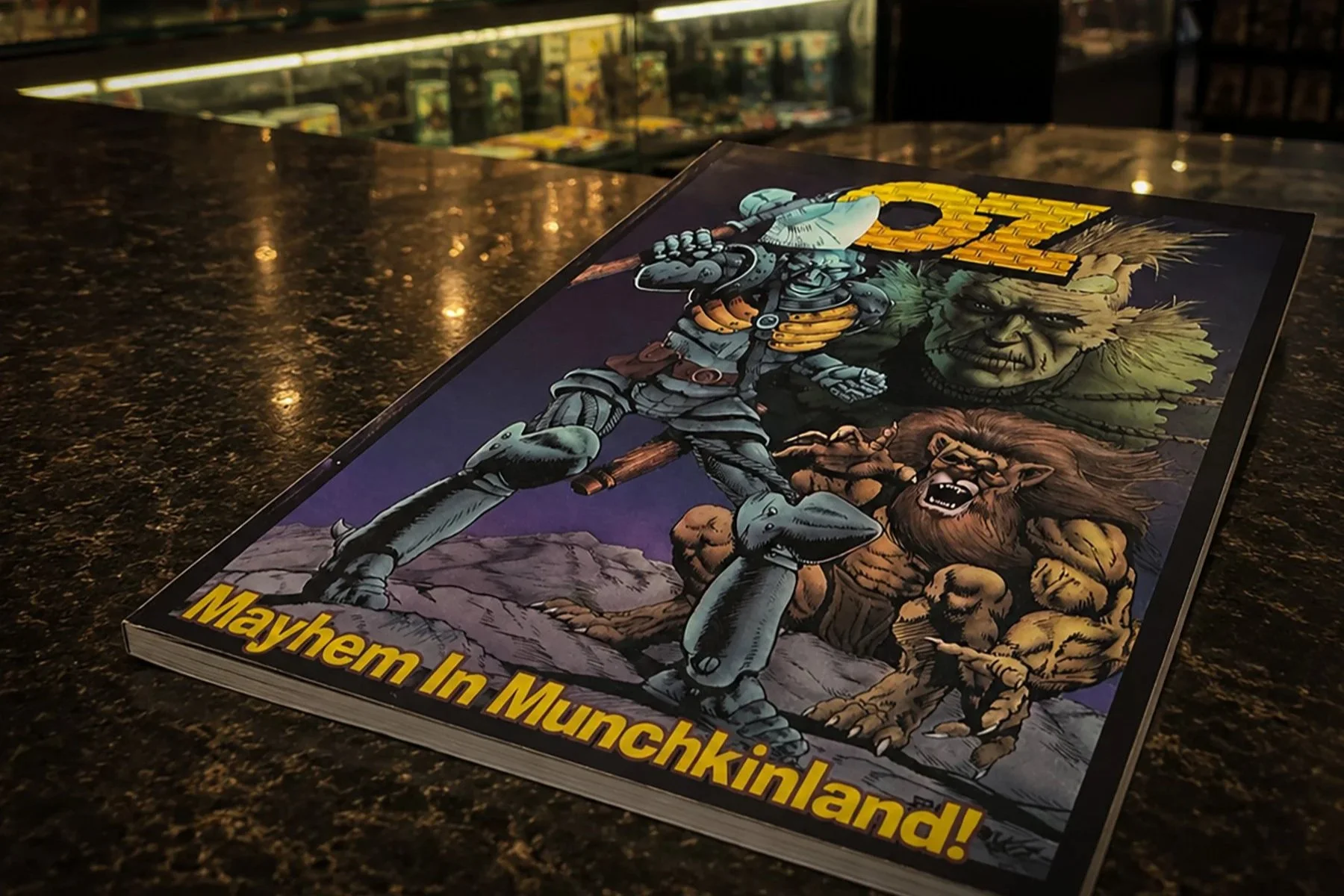
The trade paperback Mayhem in Munchkinland became my gateway into Caliber Comics' expansive OZ saga, revealing there were still unexplored roads beyond the Emerald City.
Beyond the Emerald City
Like many readers of my generation, my introduction to Oz began with familiar landmarks. There was the 1939 film, of course, but there were also Baum's novels and Disney's Return to Oz. That film introduced many of us to characters and corners of Oz that felt darker, stranger and genuinely frightening. The Wheelers, Princess Mombi's hall of interchangeable heads and the ruined Emerald City revealed a fantasy world that held far more than ruby slippers and Munchkins. By the time I discovered Caliber's OZ, I was already convinced there were still unexplored corners of that mythology waiting to be discovered.
Caliber Comics arrived at exactly the right moment.
The mid-1990s were a golden age for independent publishers as creators looked beyond traditional superheroes and experimented with horror, fantasy, science fiction and creator-owned worlds. Caliber stood near the front of that movement, publishing books like The Crow, Deadworld, Negative Burn and dozens of other original series. OZ fit comfortably alongside those titles, eventually growing into a saga that spanned twenty issues, four specials, companion miniseries and collected editions.
The creative team proved to be an equally good match for Baum's world. Stuart Kerr and Ralph Griffith brought years of independent publishing experience to the project after helping establish Arrow Comics during the black-and-white comics boom. Their backgrounds in creator-owned storytelling gave OZ a confidence that became more apparent with every issue. Rather than rushing readers from one battle to the next, they allowed the world to grow naturally, expanding the mythology while giving its characters meaningful roles to play.
Bill Bryan completed the team with a style that evolved alongside the story. His background in illustration, commercial art, storyboarding and sculpture gave the series a distinctive visual identity, and his work became noticeably stronger as the stakes grew larger.
What impressed me most, however, was the team's command of Oz itself.
Kerr, Griffith and Bryan built their story on the foundation Baum established across fourteen novels, drawing naturally from characters and places many readers had encountered only briefly through Return to Oz. Familiar figures stepped into major roles, revealing just how expansive Baum's mythology had always been. For readers whose curiosity had been sparked by Disney's darker interpretation, Caliber's OZ became an invitation to explore the rest of Baum's world.
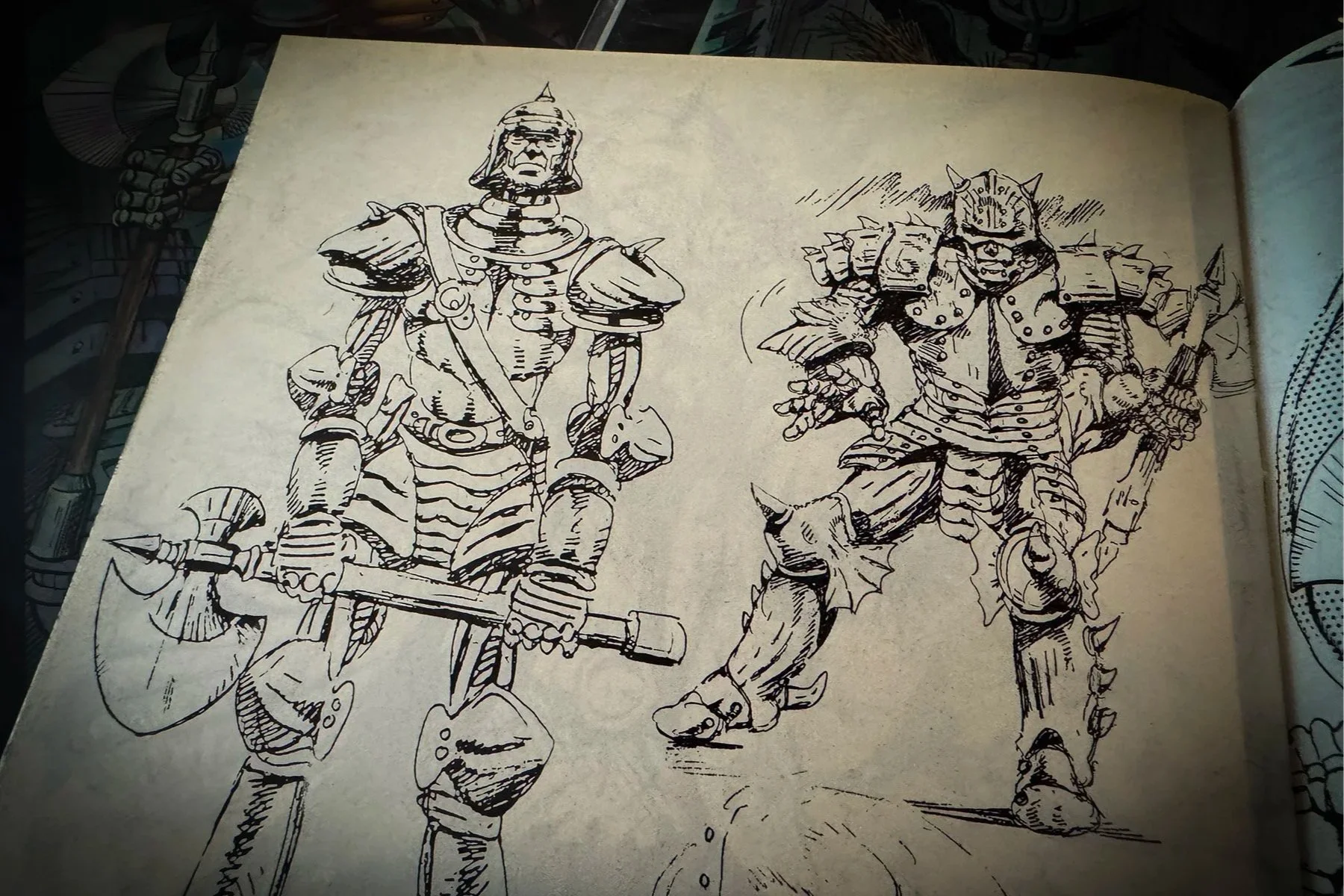
Black-and-white concept sketches from OZ #1 by Caliber Comics showing early character designs for the Tin Woodman carrying a double-headed axe alongside an armored Nome soldier.
A kingdom worth saving
The opening storyline, Mayhem in Munchkinland, follows teenagers Kevin Ross, Peter Stevens and Mary Warren after they are unexpectedly transported from Earth into a land that slowly reveals itself as Oz. The discovery unfolds the same way for readers as it does for the three teenagers. Familiar landmarks begin to appear, recognizable faces emerge from the shadows and the realization gradually sinks in that this is the Land of Oz—but decades of peace have given way to conquest.
Nothing is the way it should be.
The Emerald City has fallen under the control of the Nome King. Ozma has disappeared. The Scarecrow, Tin Woodman and Cowardly Lion have become feared generals serving the occupying forces, while Jack Pumpkinhead, Tik-Tok and a small band of Freedom Fighters fight to reclaim the kingdom. It is a wonderfully effective premise because Kerr and Griffith take everything readers thought they knew about Oz and turn it upside down. Heroes become enemies. Familiar places become battlefields. Even the Yellow Brick Road no longer promises safety.
A Gathering of Heroes broadens the story in ways I never expected. Separated across Oz, Kevin, Peter and Mary experience different corners of Baum's world, allowing the mythology to unfold naturally through their journeys. Along the way, Ozma emerges as the kingdom's rightful leader, Jack Pumpkinhead develops into one of the story's most endearing heroes and familiar faces like Tik-Tok, Mombi, Scraps and the Nome King take on far greater depth than many readers had ever seen before. Rather than treating Baum's creations as nostalgic callbacks, Kerr and Griffith weave them into the heart of the narrative, rewarding readers willing to venture beyond Dorothy's first adventure.
By the time the series reaches What Price Victory?, the conflict has grown far beyond the fate of three teenagers who accidentally found their way to Oz. The Freedom Fighters begin reclaiming the kingdom, old loyalties are tested and long-running storylines finally converge as the battle for the Emerald City reaches its conclusion. Victory comes at a cost, and the emotional weight of that cost gives the climax far more impact than a traditional good-versus-evil adventure.
New World Order proved to be one of the series' most satisfying surprises. Defeating the Nome King ends the war, but it doesn't instantly heal Oz. Leadership must be restored. Alliances must be rebuilt. Characters who spent years fighting for survival suddenly find themselves responsible for rebuilding a kingdom. That decision gives the ending a sense of maturity, reminding readers that restoring peace often requires as much courage as winning a war.
And the story didn't end there.
The Scarecrow, Lion, Tin Man and Freedom Fighters specials gave many of the supporting characters room to shine, while Romance in Rags, Straw & Sorcery and Daemonstorm expanded the mythology into still more corners of Baum's world. That ambition defines Caliber's OZ. Stuart Kerr, Ralph Griffith and Bill Bryan spent more than three years building a version of Oz that felt lived in, layered and expansive. Kevin, Peter and Mary may have introduced readers to this world, but they were only one chapter in a mythology that seemed to stretch far beyond the pages of the series.
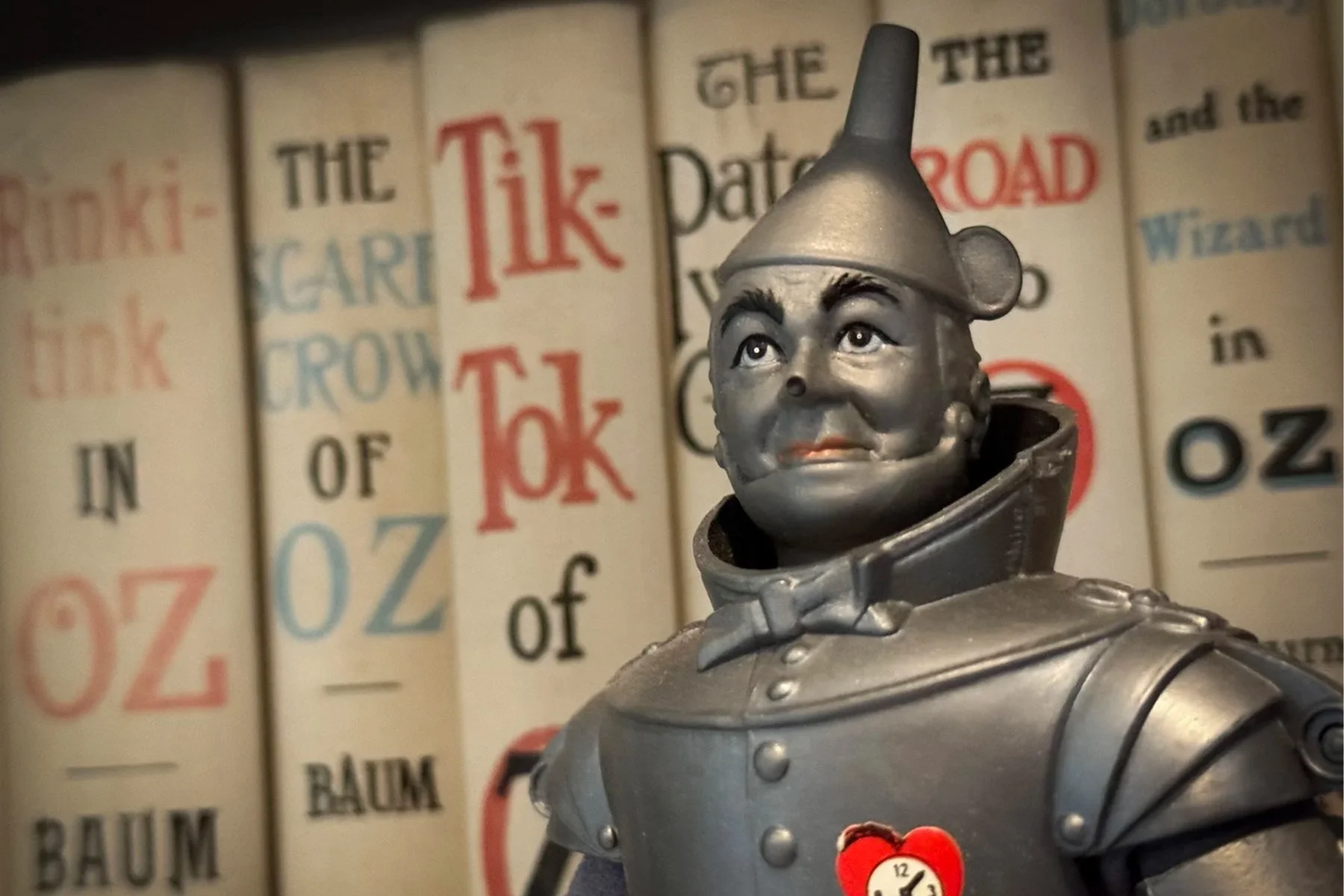
Caliber Comics may have reintroduced me to Oz, but Baum's original novels kept me there. Three decades later, there's still another road waiting beyond the Emerald City.
Off to See the Wizard
More than 125 years after L. Frank Baum first introduced readers to the Land of Oz, his imagination continues to inspire new generations. Wicked, its Broadway adaptation and the recent films have each reintroduced audiences to Oz through a different lens, proving there's still room to tell new stories inside one of fantasy's richest worlds. Caliber Comics found its own road through Oz decades earlier, but its greatest impact on me came after I finished reading it.
One of the first major purchases I made after graduate school was a complete set of the vintage Reilly & Lee hardcover editions of L. Frank Baum's fourteen Oz novels. Most people would probably assume I bought them because of childhood memories of the 1939 film. They'd be wrong. I bought them because I wanted to immerse myself in the world that inspired Caliber's OZ. Those books became the foundation of an Oz library that eventually grew to include Wicked, reference books, film memorabilia and, of course, the comics that first pointed me toward Baum's larger mythology.
Researching this article revealed that the journey still isn't over. For years, I believed my Caliber collection was complete. I owned the full series, the specials and the Dark OZ books, but digging into the publication history revealed additional Arrow Comics miniseries and one-shots that had somehow escaped my attention for more than three decades. Now I'm searching again.
Thirty years after I picked up Mayhem in Munchkinland during a lunch break from UNO, the same comic has sent me back down the Yellow Brick Road. That may be the greatest compliment I can give Caliber's OZ. The series opened a door in 1995, deepened my appreciation for Baum's world and continues to lead me toward stories I haven't discovered yet.
I'll see you on the other side of the rainbow.
Where to go next
Caliber's OZ grew far beyond the twenty-issue core series, expanding through specials, companion stories and later publications from Arrow Comics. If you're interested in following that same Yellow Brick Road, here's the roadmap.
Caliber Comics
OZ #1–20 — The complete core series (1994–1997)
OZ #0 (one-shot) — Prequel published during the series’ first year and set before OZ #1
Mayhem in Munchkinland — Trade paperback collecting Issues #1–5
A Gathering of Heroes — Trade paperback collecting Issues #6–10
What Price Victory? — Trade paperback collecting Issues #11–15
New World Order — Trade paperback collecting Issues #16–20
OZ, Volume 1: A Gathering of Heroes — 2018 edition collecting Issues #1–5
OZ, Volume 2: Clash of Titans — 2018 edition collecting Issues #6–10
Specials and companion stories (1995–1997)
Scarecrow Special (one-shot)
Lion: Beastmaster (one-shot)
Tin Man (one-shot)
Freedom Fighters (one-shot)
Romance in Rags #1–3 — Prequel miniseries centered on Scraps, leading directly into OZ #1
Straw & Sorcery #1–3 — Companion miniseries set in the Caliber OZ universe
Daemonstorm #0 — OZ chapter of Caliber’s Daemonstorm crossover
Arrow Comics
Continuation and expansion of the Caliber universe (1998–2000)
Dark OZ #1–5 — Continuation of the original OZ series
Wogglebug (one-shot) — Dark OZ story expanding the larger universe
Bill Bryan’s OZ Collection #1 — Single-issue collection of Bill Bryan’s OZ stories and artwork
The Land of Oz #1–9 — Final chapter of the core Caliber OZ sag