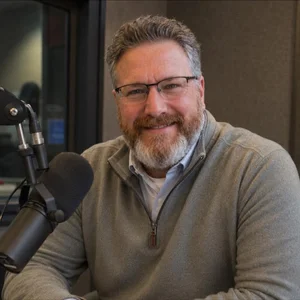
Michael Bogle built Hidden Dimension Studio around tattoos, toys and the pop-culture worlds that taught him to draw. Now he is adding Louisiana’s own kaiju to the collection.
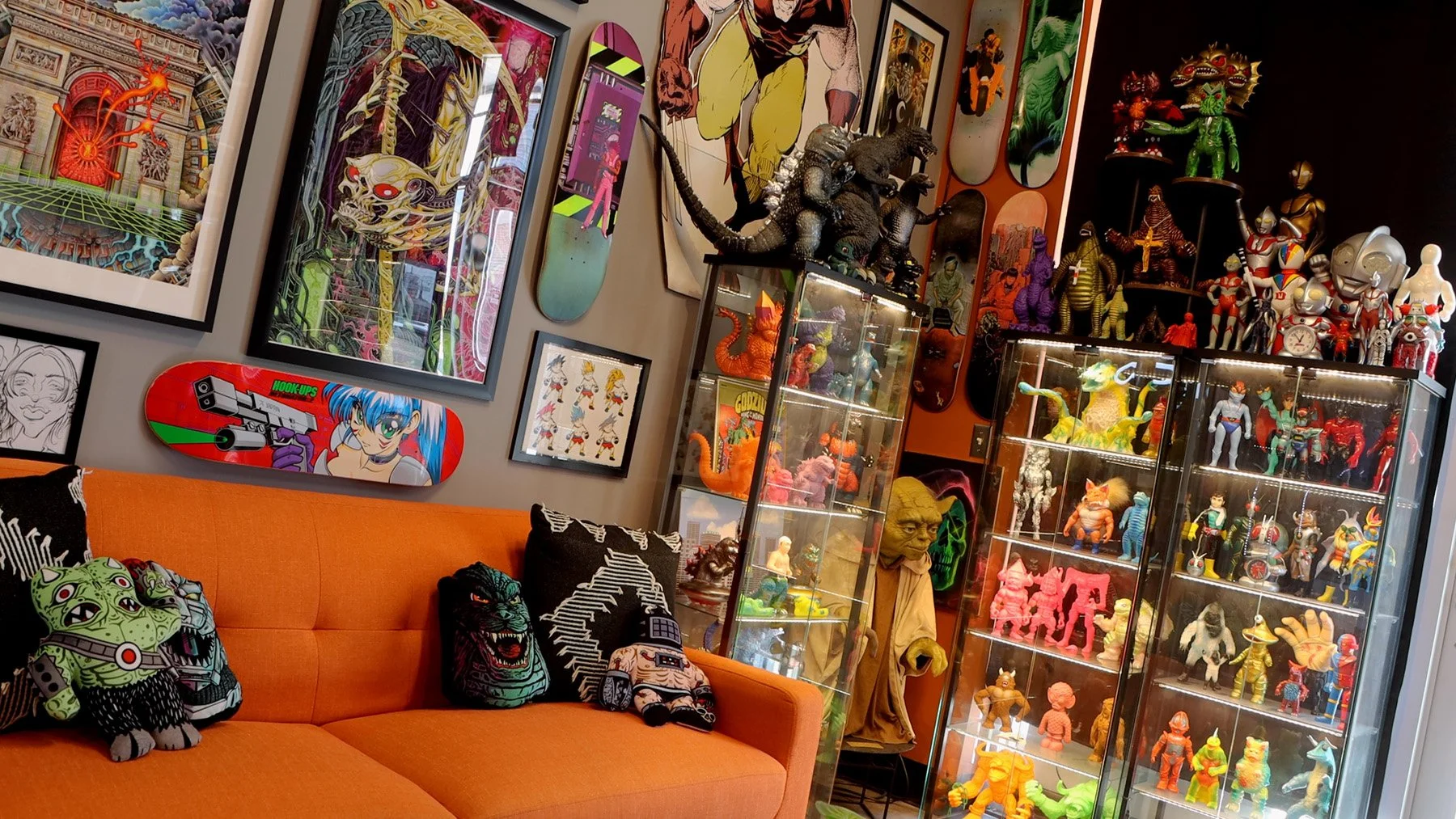
Before visitors meet the artists, Hidden Dimension Studio introduces itself through Japanese toys, original art, skateboard decks and kaiju. The collection transforms the lobby into a place where a conversation can begin before a tattoo consultation does.
Under one roof
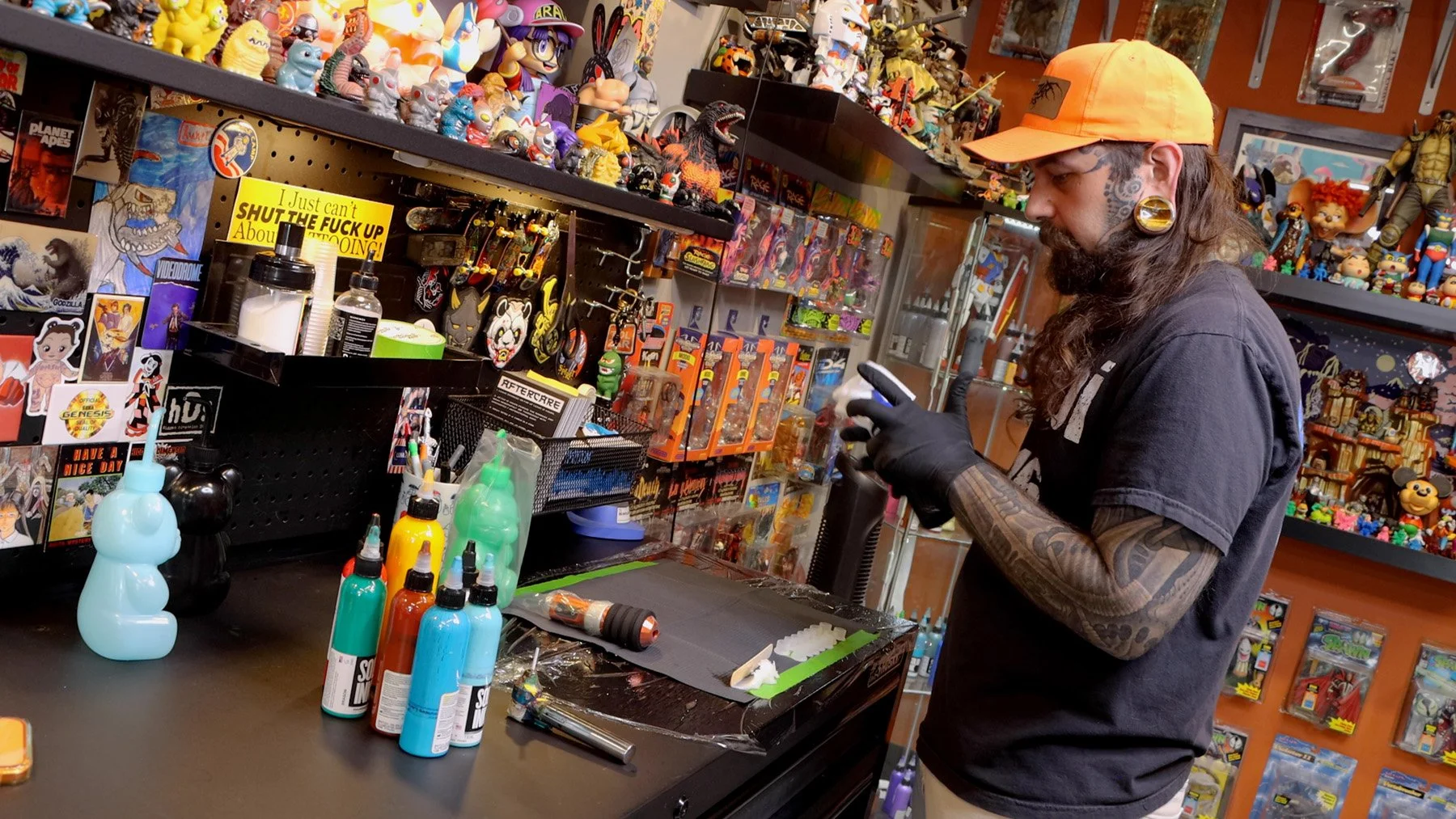
Before anyone reaches a tattoo station at Hidden Dimension Studio, the toys take over. Japanese robots, kaiju, arcade cabinets and original art fill the front of Michael Bogle’s studio on St. Claude Avenue in Arabi. Godzilla shares the room with Gundam, Ultraman, Spawn and Alien. Some visitors arrive without any intention of getting tattooed. They discovered the collection through Instagram or TikTok and simply want to see what is inside. Bogle is happy to let them look and even happier when they want to talk about toys.
The studio feels like a comic convention, arcade and animation studio folded into a tattoo shop. It is also the natural extension of a childhood spent watching VHS tapes and drawing alone in his room. “I was really into escapism as a child,” Bogle said. “That was a bubble of my own world, so I watched movies and drew stuff. Now I draw stuff from movies for a living and basically live in a toy store, so I’m happy as could be.”
Bogle describes himself first as a tattooer, but that label no longer covers everything happening around him. He is also a graphic designer, collector, toy producer and the writer of his first graphic novel. Inside Hidden Dimension, those pursuits do not compete for space. Each one has grown from the last, creating a cycle in which tattooing leads to collecting, collecting leads to production and the toys introduce an entirely new audience to his tattoo work.
Creating his own hidden dimension
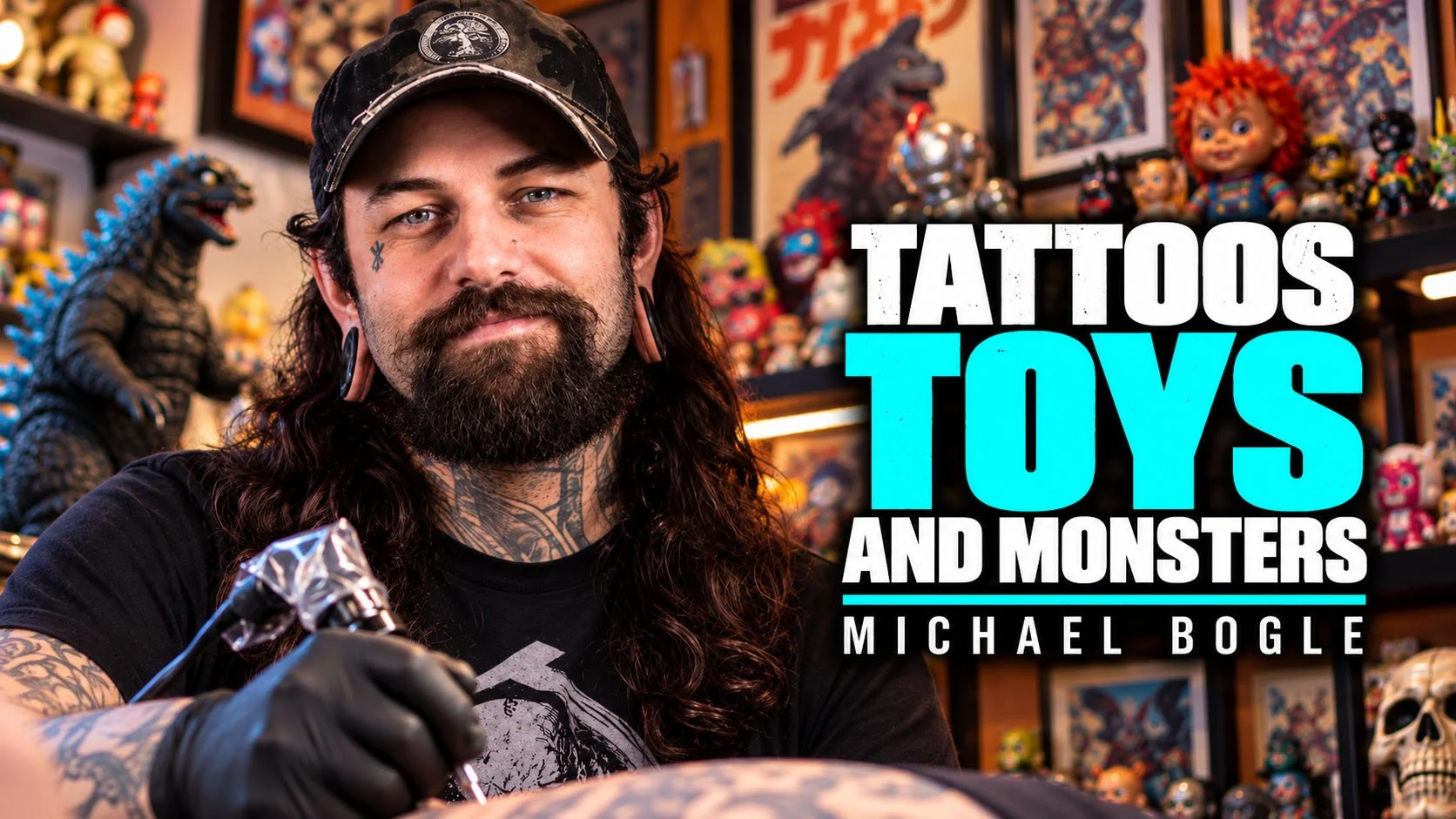
Now hear Michael Bogle’s story in his own words. Step inside Hidden Dimension Studio in Arabi, where tattoos, Japanese toys and pop culture share the same creative space, and discover how a lifetime of collecting led Bogle to create King Krawju and a graphic novel of his own. Watch on YouTube, then like, comment and subscribe to support more original POP nakaro stories.
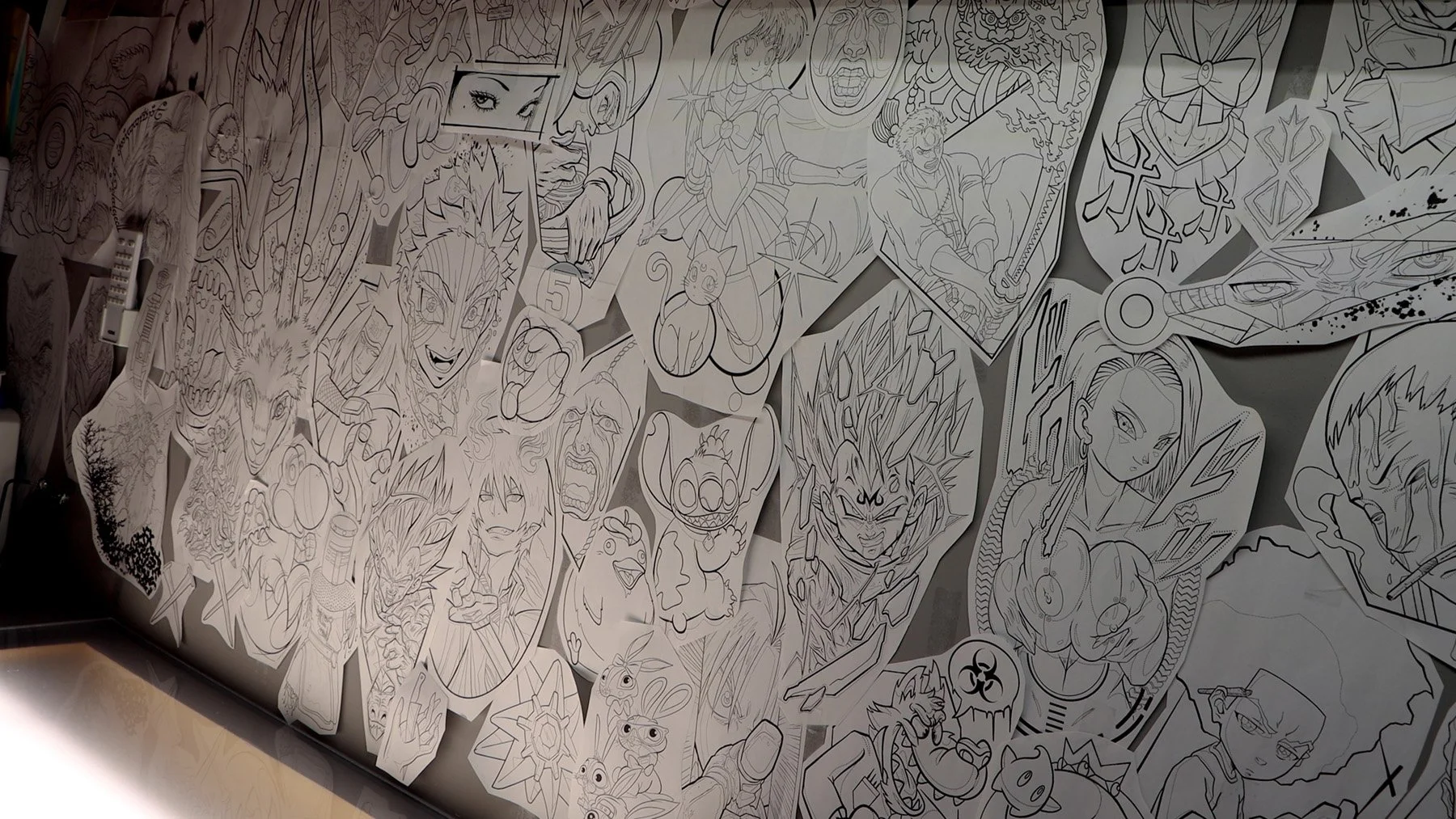
Bogle once imagined working inside an animation studio surrounded by drawings, toys and creative people. The illustrated walls of Hidden Dimension bring part of that childhood vision into the tattoo studio he eventually built for himself.
Drawing his own path
Long before Bogle considered tattooing, he wanted to make movies or become an animator. As a child, he saw photographs of animation studios in magazines and studied the rooms almost as closely as the work. The adults inside appeared to spend their days surrounded by toys, drawings and other creative people while being paid to develop new ideas. That possibility stood in sharp contrast to the adults he knew who did not enjoy their jobs and carried that frustration home with them.
Bogle grew up in the 1990s, when Nickelodeon and the larger culture regularly told children they could become whatever they imagined. His parents reinforced the message. “You can do anything you want,” they told him. “Just go for it.” He took them seriously and began thinking early about the kind of life he wanted to build.
Animation remained appealing, but the industry surrounding it did not. The more Bogle understood the scale of filmmaking, the more he recognized how many executives, financiers and other decision-makers could stand between an artist and the finished work. Tattooing offered another model. He discovered it through the punk-rock and skateboarding scenes and realized he could remain creative without surrendering the process to a committee. Instead of satisfying a dozen people financing an animated production, he needed to satisfy himself and one client.
The decision made less sense to his family and friends 20 years ago than it does today. Tattooing had not yet reached its current level of mainstream acceptance, and the people around him thought he was taking an enormous risk. Time changed the conversation. “Now they get it,” he said. “They say, ‘Okay, you clearly knew what you were doing.’”
Finding a way into the profession still took persistence. While living in Hammond, Bogle spent two years searching for an apprenticeship. Artists in the area were reluctant to train someone they viewed as future competition, so he began learning from the other side of the machine. He got tattooed at Eye Candy Tattoo in New Orleans and paid close attention to how its artists planned large pieces, conducted consultations and built an experience around the work. He practiced on himself and on friends from the skateboarding and punk scenes who already trusted him as an artist.
“I didn’t know how to tattoo a neck, so I got my neck tattooed,” he said. “I didn’t know how to tattoo a hand, so I got my hand tattooed.”
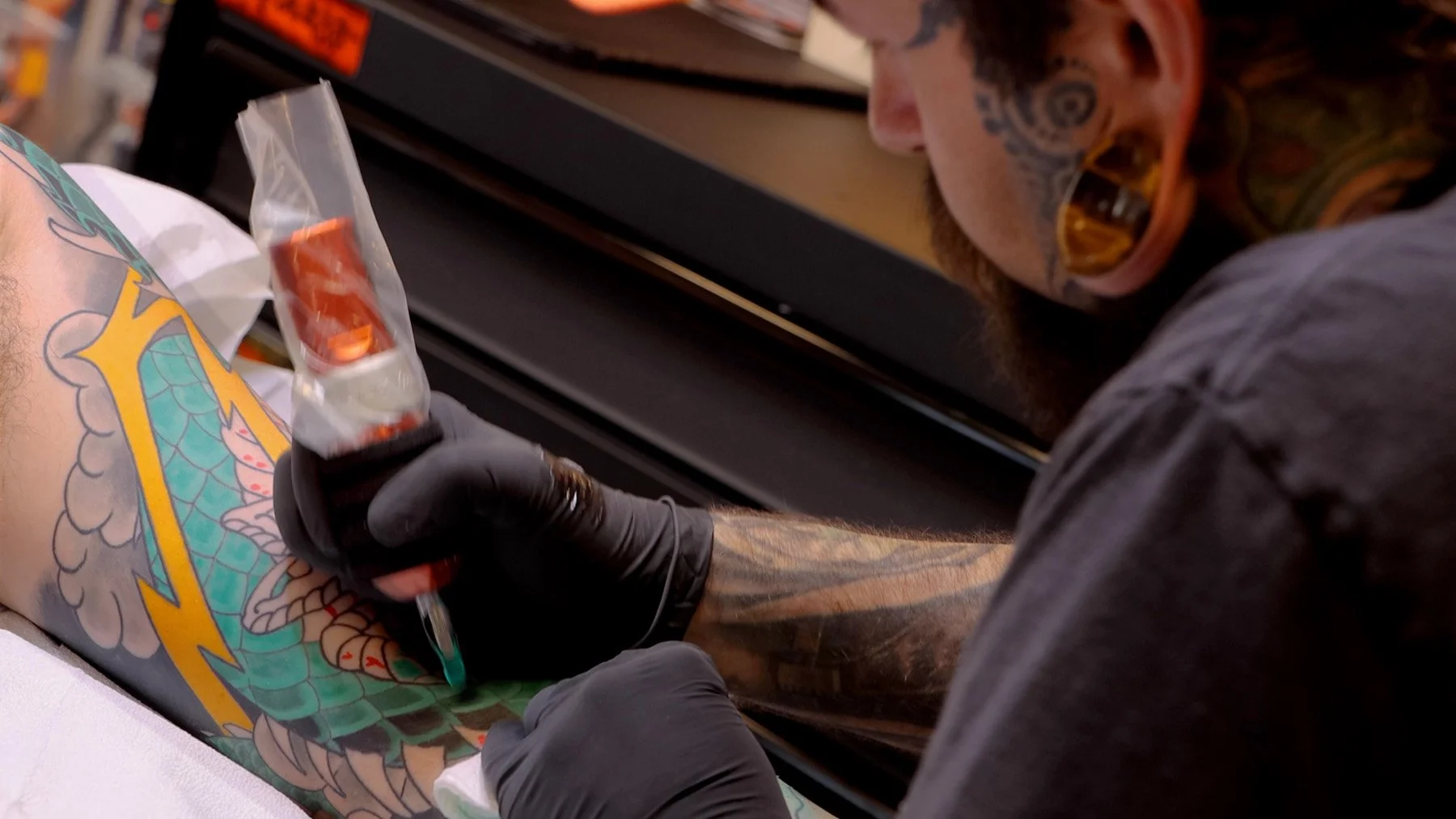
Bogle specializes in large custom tattoos developed through consultations and completed across multiple appointments. The extended process often turns clients into collectors—and, in many cases, lasting friends.
Collecting tattoos
ogle eventually learned that tattoos could be collected much like paintings, comics or toys. Serious clients did not simply visit the nearest shop and work with whoever happened to be available. They followed individual artists, studied their styles and sometimes traveled around the world to build a body of work one appointment at a time.
He began doing the same, traveling to cities including San Francisco and New York to be tattooed by artists whose work he had discovered through magazines, documentaries and the growing tattoo community. Each offered something specific, much like a painter whose technique could never be separated from the finished canvas. Those experiences sharpened Bogle’s understanding of what clients were seeking when they traveled to him.
Most find him online, recognize his style and approach him with an initial idea. Bogle compares choosing the right tattooer to hiring someone to work on a house. A skilled electrician and a skilled plumber may both be excellent at their jobs, but they are not interchangeable. When a client brings him an idea better suited to another artist, he makes the referral. When the project fits his work, the consultation becomes the foundation for everything that follows.
Bogle meets the client, studies the person’s personality, takes measurements and determines how the composition should move across the body. They draw together until both understand the direction. That communication is especially important because Bogle specializes in large custom pieces that may cover an arm, back or torso. Clients typically return once a month, and a project may take six months to a year depending on its size and complexity.
The drawing and design happen largely on his days off, but Bogle considers the consultation the most important part of the process. Years of experience have taught him to resolve the major questions through conversation before investing hours in a finished drawing that moves in the wrong direction. “You point us in the direction,” he tells clients, “and I’ll take us on the journey.”
Those journeys often last long enough for the relationship to extend beyond the tattoo. Bogle estimates that at least half of his friends began as clients with interesting ideas. Months of appointments became dinners, visits and friendships that continued after the work was finished. For Bogle, a client returning simply to spend time at the studio is one of the clearest signs that the experience became something larger than a transaction.
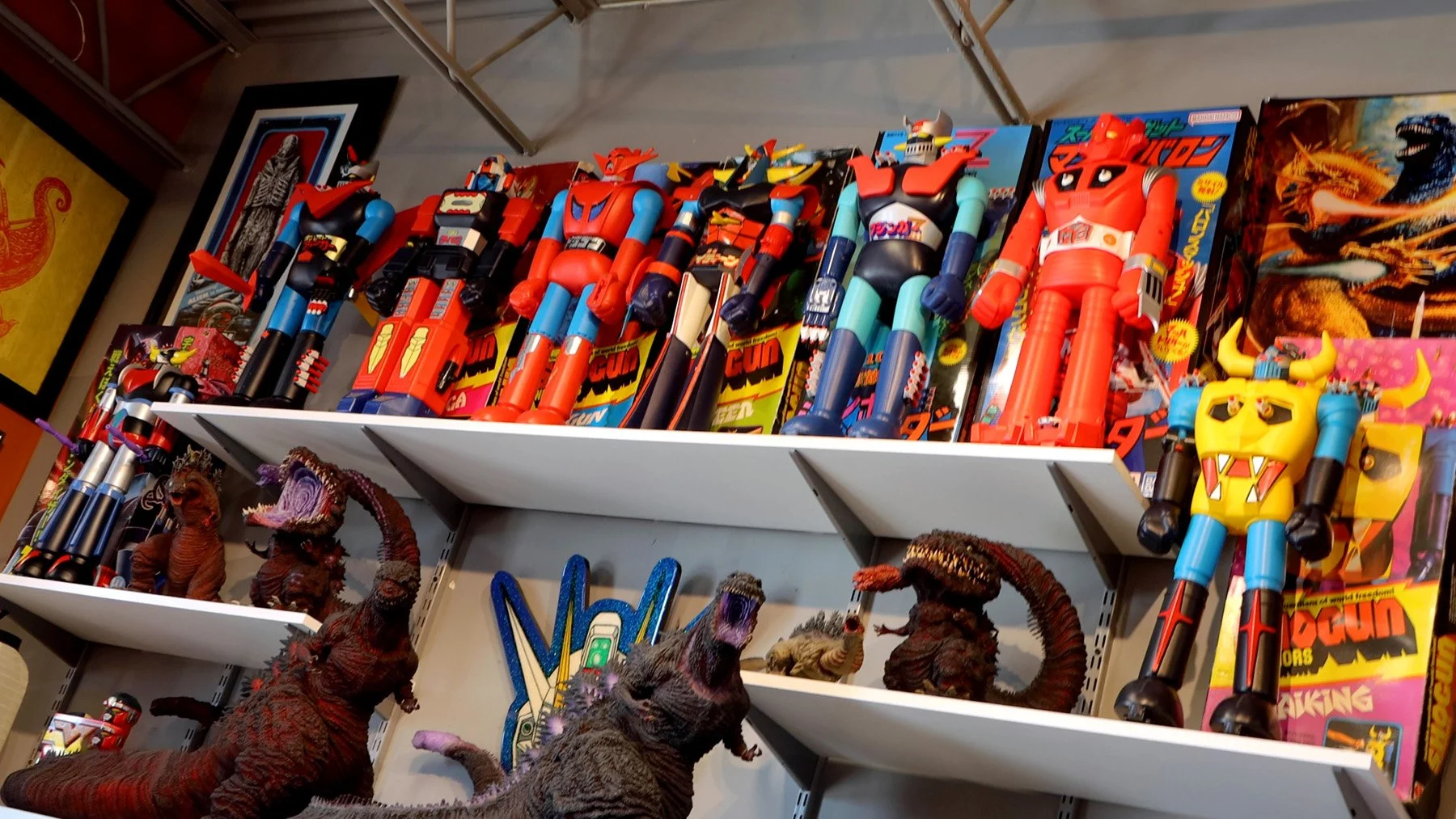
Shogun Warriors, Godzilla figures and other Japanese characters reflect the pop-culture influences that shaped Bogle’s art. Collections throughout the studio also help clients recognize shared interests before the tattooing begins.
A studio built for connection
The subjects Bogle tattoos often come from the same comics, animation, anime and movies that taught him to draw. Early in his career, he recognized an audience for pop-culture tattoos that did not pass through what he calls a “tattoo filter.” If a client wanted Spider-Man, the character should look as though he came from a comic panel. An action scene should retain the movement and energy that made it exciting in the first place.
That approach carried Bogle far beyond New Orleans. After several pages of his work appeared in a Star Wars tattoo book, he was invited to tattoo at Star Wars Celebration. Other conventions followed, placing him in front of audiences already interested in the subjects he most wanted to draw. The travel expanded his career, but years on the convention circuit eventually left him burned out. When the pandemic forced that schedule to stop, he redirected his attention toward creating a permanent world of his own.
Hidden Dimension Studio opened in June 2021 at 6723 St. Claude Ave. Bogle began with a question similar to the one that had guided his career: People have fun in comic shops, arcades and conventions, so why not bring that energy into a tattoo studio? The idea addressed more than the appearance of the room. At a previous shop, he watched new visitors enter quietly, withdraw into their phones and speak in whispers. Once they realized the artists shared their interests in movies, comics and games, the tension usually broke. Hidden Dimension was designed to establish that connection before anyone sat down.
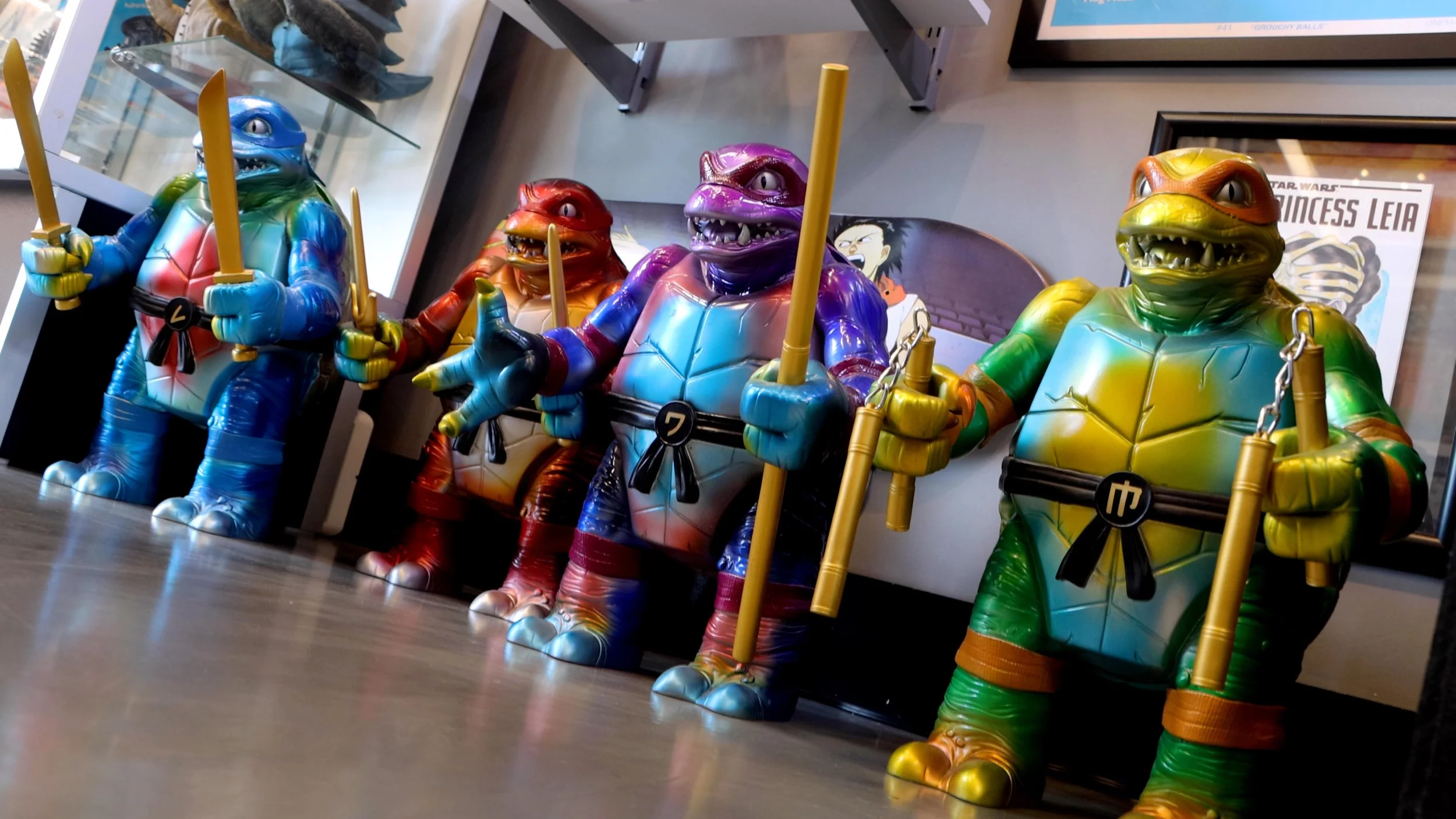
The Japanese toy collection begins in the lobby, which operated as a retail toy store for approximately two years. After Bogle sold everything he was willing to part with, the shop gradually became more of a gallery. The tattoo stations begin beyond the counters, with each artist encouraged to build a personal collection around an individual workspace. Larger and more elaborate procedures happen farther back, and even the bathroom continues the experience with a full 1990s Teenage Mutant Ninja Turtles theme.
Bogle’s interests move between Japanese and American pop culture. Godzilla, Ultraman, Shogun Warriors, Evangelion, Gundam and Guyver share his attention with vintage Looney Tunes and Disney pieces, Terminator, Spawn and The Maxx. He entered comics as Image was emerging in the 1990s, leaving him especially interested in characters outside the familiar Marvel and DC lineup.
His favorite category may be the most revealing: action figures based on R-rated movies. As a child, he was not allowed to watch the films, yet toy companies occasionally placed their monsters and heroes within reach on store shelves. As an adult, he remains fascinated by that contradiction. His boxed 1979 Kenner Alien—an oversized figure based on a film clearly not made for children—captures it perfectly.
Other objects carry stories that are not apparent at first glance. A small ceramic fox head purchased at a shrine in Japan holds more personal value than its price suggests. Hand-painted Ghanaian movie posters connect Bogle with artists continuing a tradition that began with advertisements painted on repurposed flour sacks. A working Evangelion pachinko machine came from a Japanese arcade. A rare Guyver bust took years to locate before he found one through a private collector in the United Kingdom. Visitors can walk through the studio two or three times and continue noticing things they missed. That is part of the appeal.
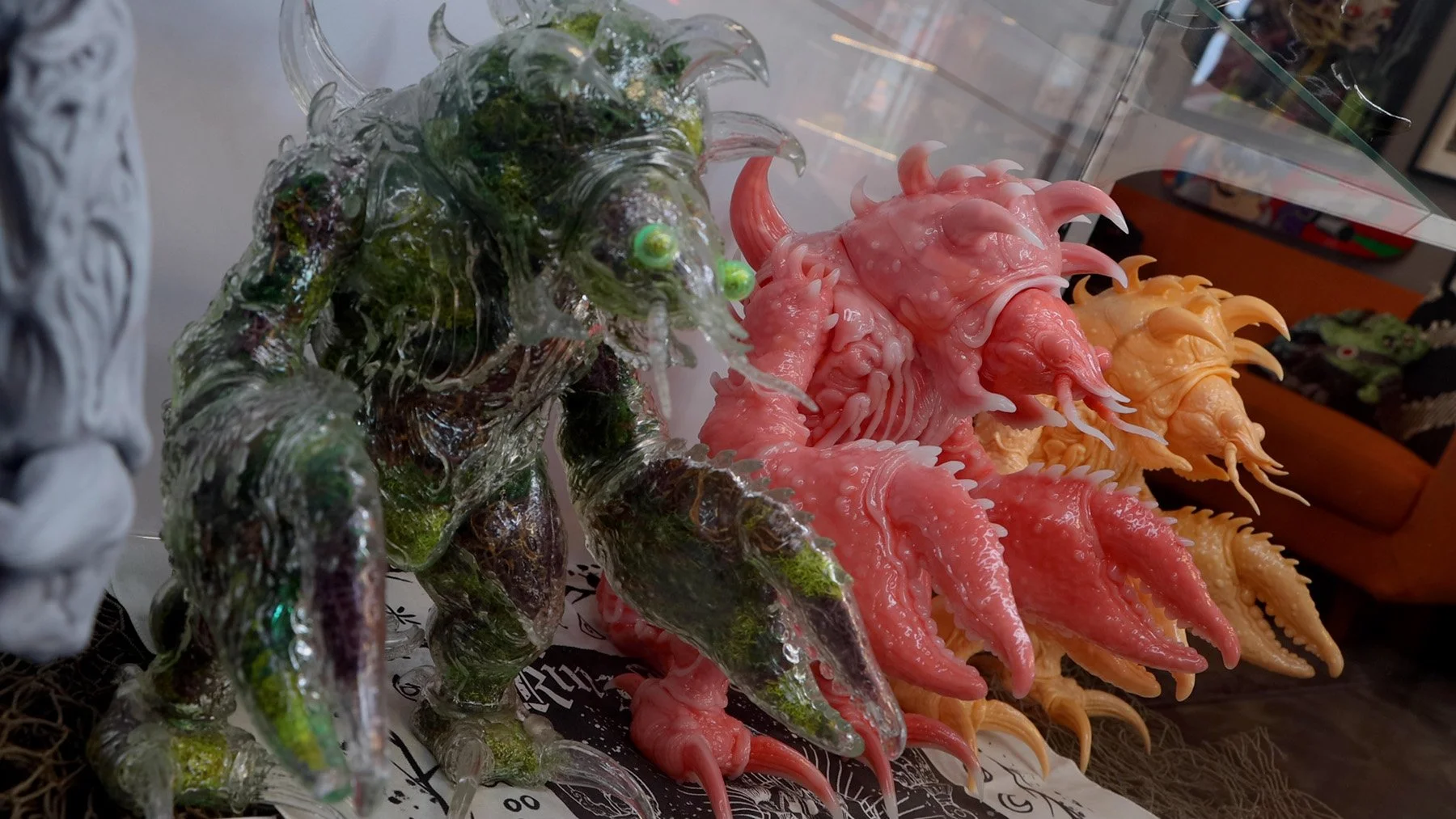
A crawfish photographed during a family boil became King Krawju, the God of the Southern Bog. The Louisiana-born kaiju moved Bogle from collecting designer toys to producing creatures that could enter other people’s collections.
God of the Southern Bog
The collection also opened doors beyond tattooing. Clients noticed that Bogle built and designed things, leading to graphic-design assignments and opportunities within the film industry. Eventually, surrounding himself with the work of other creators made him want to put something of his own on the shelf.
The idea surfaced during a family crawfish boil. While everyone else was eating, Bogle began photographing a crawfish from a low angle with his phone. His family wanted to know what he was doing. They had asked similar questions when he announced plans to become a tattooer, and they asked again when he said he wanted to produce toys. Years later, those photographs had become the foundation of a successful figure and a new creative brand. His family has learned that when he begins doing something unusual, another project is probably taking shape.
Bogle started with a direct question: If a giant kaiju emerged from Louisiana, what would it look like? The crawfish supplied the anatomy. The swamps, folklore and personality of the state supplied an identity. The result was King Krawju, the God of the Southern Bog.
He spent months working with a sculptor, drawing over early forms and refining the creature as it moved from a two-dimensional design into a physical object. He carried images of the prototype to toy conventions and discussed the project while buying work from other producers. One recognized its potential and connected him with a manufacturer.
In 2022, Bogle launched Tolzar Toys with an elaborate sofubi-style King Krawju standing approximately 12.5 inches tall. Beginning with a large, multipart designer toy was an ambitious first step in an industry where new producers typically start with something smaller and easier to manufacture. “Ignorance was kind of bliss for me,” he said. “I just really went for it.”
The figure made an impression. Collectors were surprised that something so large and complex was Bogle’s first release, and its reception gave Tolzar Toys room to grow. A smaller Son of Krawju followed, offering a different scale and factory-painted format. Bogle later returned to larger and more detailed pieces through the XL Hyper Real series. Some are sold as blanks, while others receive custom paint or become limited collaborations with guest artists.
Producing King Krawju changed Bogle’s relationship with collecting. He was no longer only searching for objects that reflected his interests. Something that began in his sketchbook could now enter collections around the world.
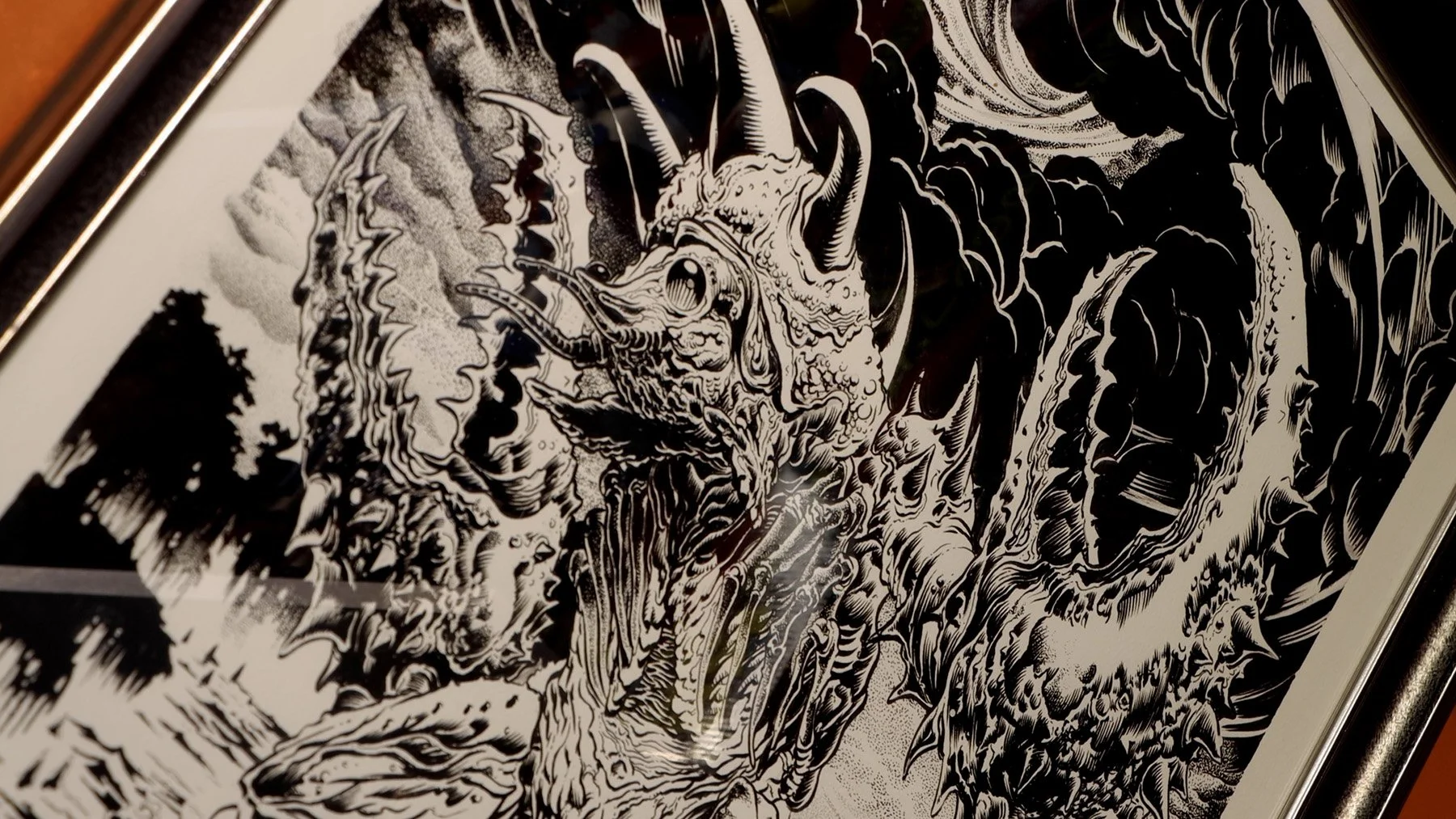
King Krawju began as a toy, but Bogle soon saw the possibility of a larger world. Detailed creature artwork helped move the character beyond the shelf and toward the darker mythology of GOD-KING: Incarnation.
Building the mythology
After working with King Krawju for several years, Bogle realized that the creature needed a history and a world around it. He compares the process to the creation of He-Man: Begin by designing the most exciting toy possible, then develop the mythology that explains who the character is and where it belongs.
That mythology is becoming GOD-KING: Incarnation, a 200-page horror graphic novel written by Bogle and illustrated by Gabo Elias in Chile. Bogle spent much of 2025 writing, editing and reshaping the story into a script. Elias had recently completed a three-year contract working on a Call of Duty graphic novel and was interested in moving toward something entirely different. At the time of our interview, the book was approximately 70% complete, with Bogle aiming to finish it in early 2027.
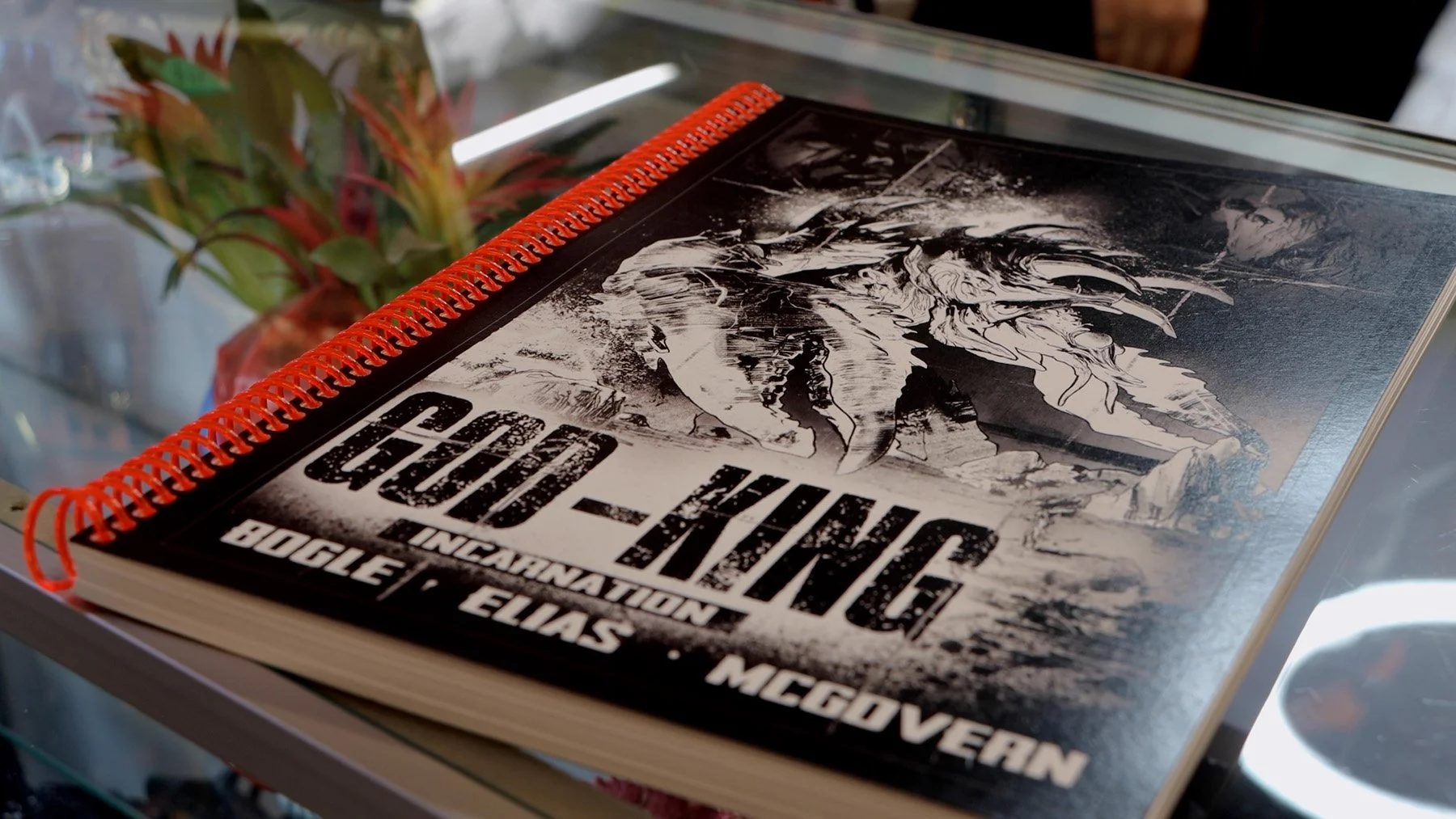
The story follows a feral tribe that communicates with the deities it worships through psychedelics brewed by its shaman. When the ritual goes wrong, the shaman’s grandson—who is learning to assume his place within the tribe—emerges as a messianic figure capable of becoming a kaiju himself.
Bogle wanted the destruction to feel more personal than the collapsing skylines common to giant-monster stories. Buildings are routinely crushed in kaiju films, but the human consequences often remain somewhere beyond the frame. His story moves closer, combining giant-monster scale with horror intended for readers 15 and older.
The book extends a process already visible throughout Hidden Dimension. Tattooing gave Bogle a creative career and taught him how to communicate with clients. Those clients introduced him to serious collectors and changed the way he built his own collection. Collecting pushed him toward producing toys, and producing toys connected him with people who later became tattoo clients. Graphic design, filmmaking and now comics expanded from the same foundation.
When Bogle began tattooing, he was too broke to imagine owning much of what now surrounds him. Today the toys, tattoos, original characters and pages of a graphic novel all occupy the kind of creative room he once studied in magazines. What began with VHS tapes and a sketchbook now fills an entire studio, and every object offers another entrance into the world he spent his childhood imagining.

Where to go next
Hidden Dimension Studio combines custom tattooing with a gallery filled with Japanese toys, kaiju, arcade games and original art. Visitors can explore the collection, review the artists’ portfolios or begin planning a custom tattoo project.
Hidden Dimension Studio
6723 St. Claude Ave.
Arabi, LA 70032
(504) 766-7125
Studio hours:
Tuesday–Saturday: Noon–6 p.m.