Design beneath Nola’s feet
How a century-old water meter cover became one of New Orleans's most recognizable works of everyday design.
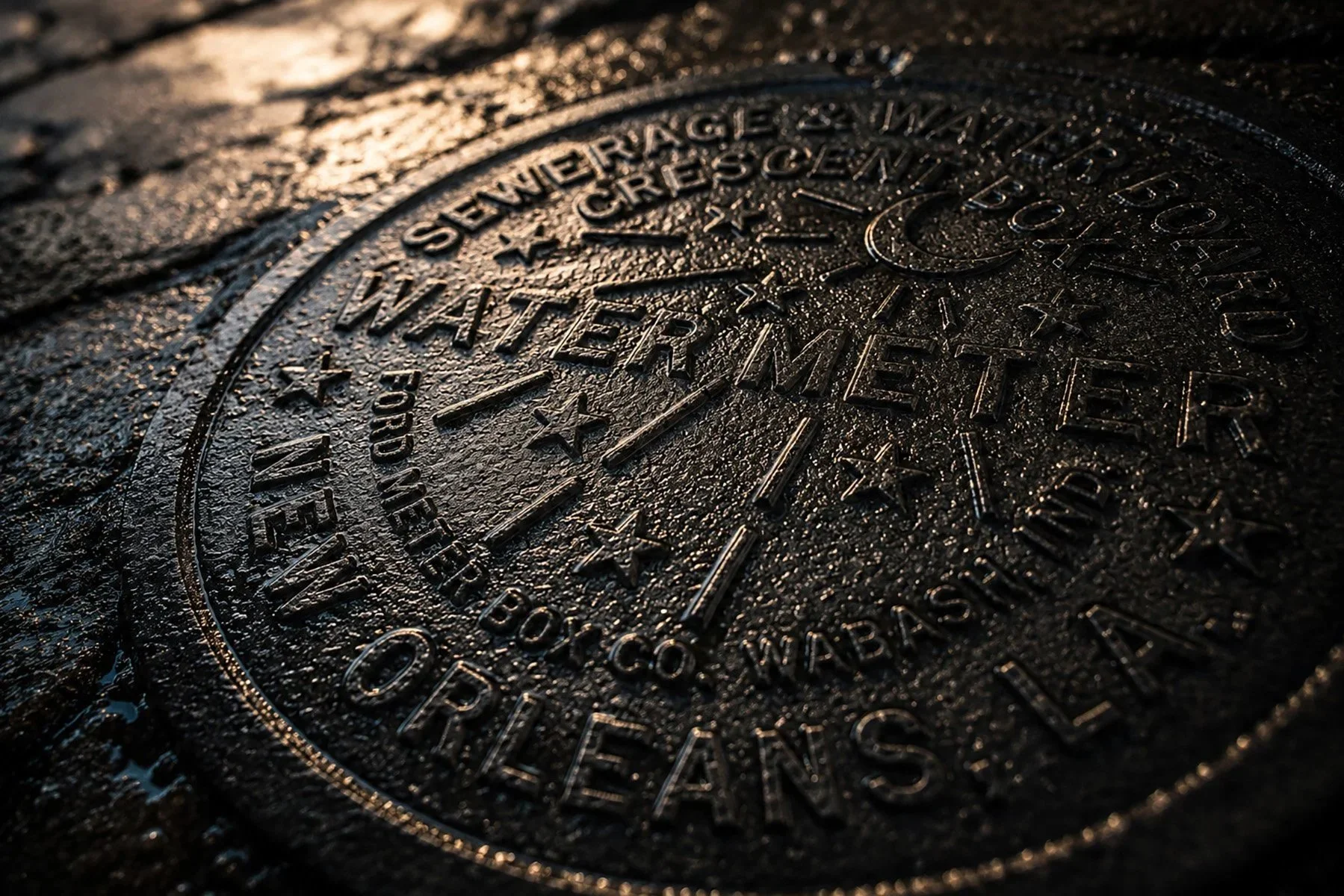
A Crescent Box water meter cover glistens on a rain-soaked New Orleans sidewalk, its familiar moon-and-stars design carrying more than a century of civic history.
Some stories wait in museums
Some stories wait for us in museums. Others have been beneath our feet all along.
Growing up, I may have lived in St. Bernard Parish, but for most of the week New Orleans was every bit as much home. Whether I was headed to school in the Marigny, playing softball in the Bywater or simply making my way around the city, one familiar object always caught my attention. Set into sidewalks across New Orleans was the same cast-iron cover, its face defined by a crescent moon, nine stars and the words WATER METER.
About fifteen years ago, I bought an authentic Crescent Box cover—one that had never been installed beneath a city sidewalk. It was probably more impulse than planning, but living on the Northshore, I appreciated having an unmistakable piece of New Orleans close at hand.
What I didn't appreciate—at least not yet—was the story beneath the iron.
Like many POP nakaro stories, this one began with a simple question. The deeper I dug, the less I found myself reading about water meters and the more I found myself reading about engineering, industrial design, civic identity and the evolution of New Orleans itself.
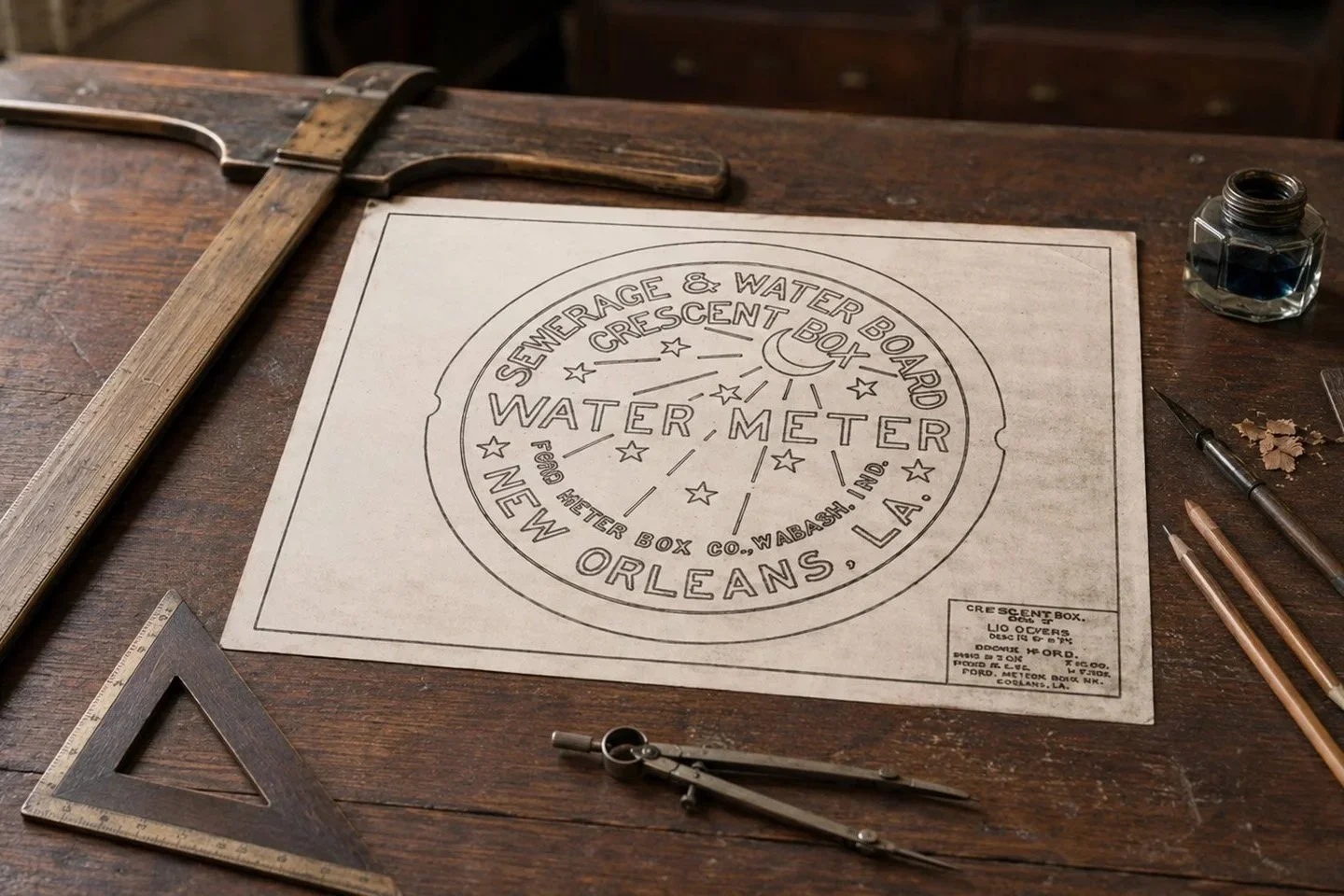
Edwin Ford’s Crescent Box design combined practical engineering with the civic identity of New Orleans.
An engineer solves a New Orleans problem
The story of the Crescent Box doesn't begin in Louisiana. It begins nearly 900 miles away in Wabash, Indiana, where Edwin Ford founded the Ford Meter Box Company.
According to the company's centennial history, George G. Earl, chief engineer and general superintendent of the New Orleans Sewerage & Water Board, approached Ford in 1921 with a problem unique to the Crescent City. Conventional meter boxes weren't suited for New Orleans' unstable soil. As the ground settled, rigid cast-iron boxes rose above sidewalks while open-bottom designs filled with mud and attracted wildlife, including crawfish and gophers.
During a visit to New Orleans, Ford sketched ideas at the Sewerage & Water Board offices before returning to Indiana to build a prototype. The finished design featured a solid cast-iron bottom, drainage openings and an adjustable threaded barrel that could be raised or lowered as the city's sidewalks shifted. The Sewerage & Water Board approved the design, ordered the first 100 units and Ford received U.S. Patent No. 1,495,011 in 1924.
The invention proved transformative. John Ford later recalled that by 1924 nearly half of the company's business came from manufacturing Crescent Boxes for New Orleans, helping establish Ford Meter Box during its formative years. More than a century later, the company still highlights the Crescent Box as one of its defining achievements.
The engineering explains why the Crescent Box exists. It doesn't entirely explain why it has endured.
The answer lies in the era that produced it. In the early twentieth century, Americans expected public works to contribute to the character of their communities. Railroad stations, banks, courthouses, bridges and even streetlights were designed with permanence and civic pride in mind. The Crescent Box belongs to that tradition. In 1921, it wasn't unusual to believe that even a water meter cover deserved thoughtful design. What's remarkable is that New Orleans never stopped valuing it.
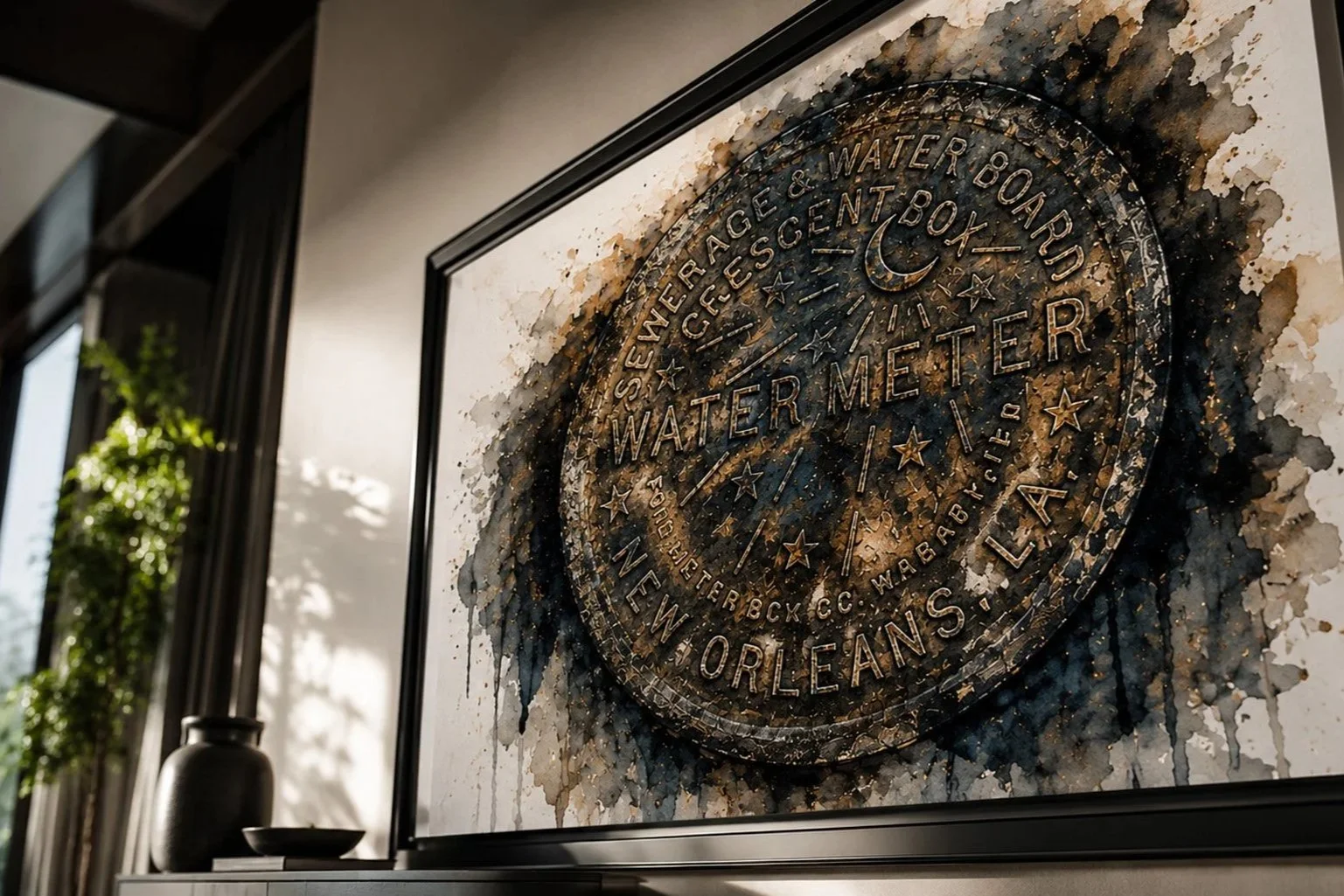
The Crescent Box transforms a practical piece of infrastructure into a lasting expression of New Orleans identity.
The art of utility
Looking at the Crescent Box today, it's difficult to see it as just a piece of municipal infrastructure.
After nearly three decades working in graphic design, branding and communications, I've learned that strong design never happens by accident. Every successful logo, publication or sign begins with deliberate choices about balance, hierarchy and composition. The Crescent Box reflects that same thoughtful execution, remaining visually compelling more than a century after it was first cast.
Viewed through a designer's eyes, the composition is remarkably disciplined. The crescent anchors the piece while radiating lines draw the eye toward the center. Nine stars balance the surrounding space without overwhelming it. The words WATER METER establish the cover's purpose before the remaining typography guides the viewer through ownership, manufacturer and location in a clear visual hierarchy. Even the curved lettering reinforces the circular casting, creating a design that feels complete from every direction.
According to Ford Meter Box's centennial history, the original casting included both the crescent moon and nine stars, though the company offers no explanation for why that arrangement was chosen. The crescent had long been associated with New Orleans. Decades before the Crescent Box was created, the city's nickname as the Crescent City was already well established, and the New Orleans Police Department had incorporated the symbol into its badge. Whether Edwin Ford selected the imagery himself or developed it with George G. Earl and the Sewerage & Water Board, the finished design immediately felt as though it belonged to New Orleans.
That may be the Crescent Box's greatest achievement. It did more than identify a piece of infrastructure—it gave one an identity. While most cities simply labeled their infrastructure, New Orleans created something people would recognize, remember and ultimately claim as its own.
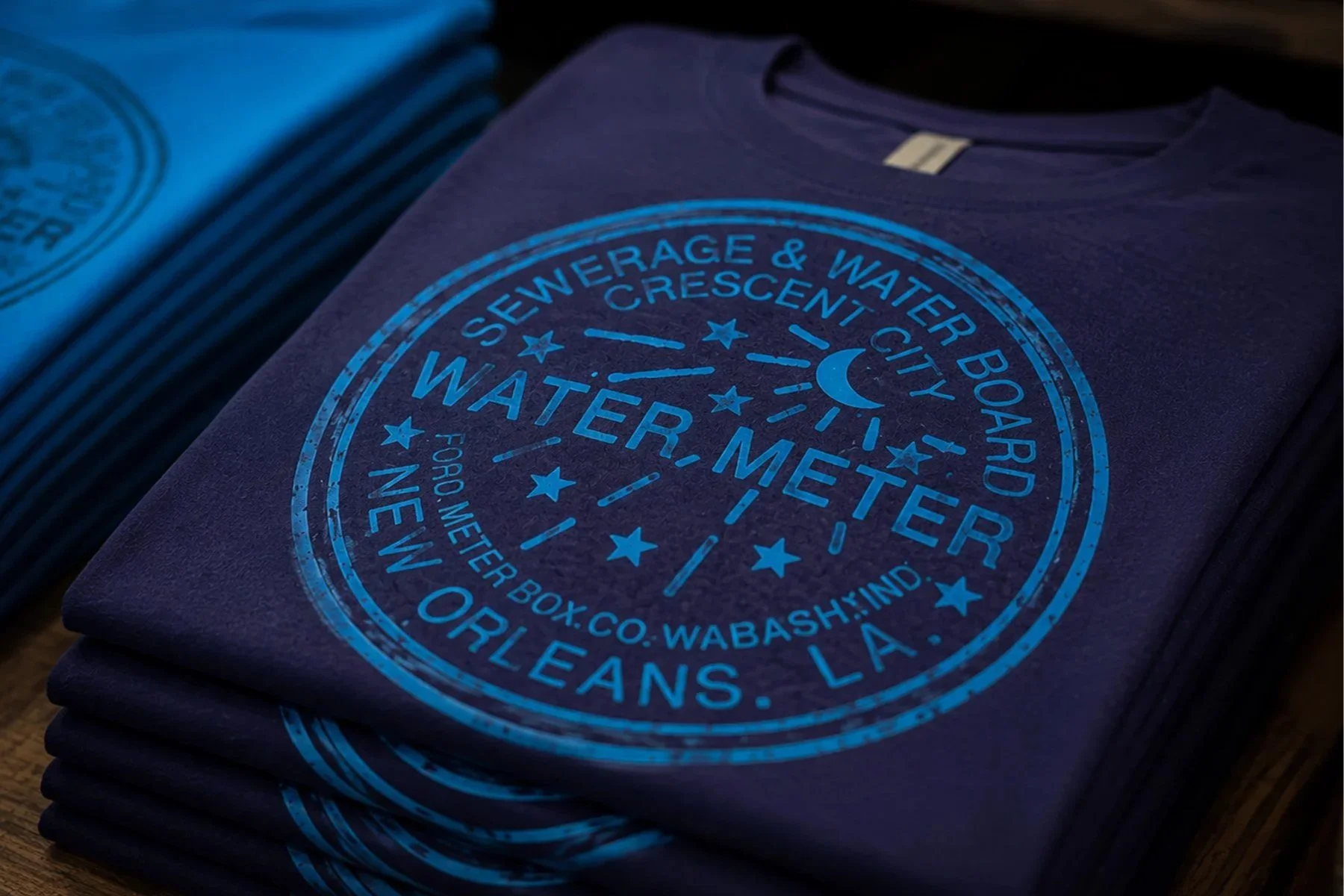
Once confined to New Orleans sidewalks, the Crescent Box design now appears on clothing, jewelry, artwork and home décor as a symbol of the city.
When infrastructure became culture
For generations, the Crescent Box’ cover quietly became part of everyday life in New Orleans.
Children crossed it on their way to school. Families stepped over it in the French Quarter. It appeared along parade routes, neighborhood sidewalks, corner groceries and countless front porches. Like the city's streetcars, cast-iron balconies and shotgun houses, it became one of those familiar details that helped define New Orleans without demanding attention. It wasn't celebrated because anyone told people to admire it. It became recognizable because generations simply lived alongside it.
That familiarity took on new life after Hurricane Katrina.
The Sewerage & Water Board later noted that the Crescent Cover design began appearing on jewelry, clothing, artwork, home décor and other products celebrating the city's identity. Tulane Magazine likewise observed that what had once been municipal infrastructure had become part of New Orleans' tourism industry and post-Katrina resurgence. Artists and businesses including Fleurty Girl, Mignon Faget and Cristy Cali embraced the century-old design, reflecting how deeply it had become woven into the city's visual identity.
Recognition, however, came with an unexpected consequence. According to Ford Meter Box's centennial history, decorative Crescent Box covers had become desirable enough by the early 1970s that the Sewerage & Water Board began ordering plain replacement lids because the originals kept disappearing. More than fifty years later, WWL-TV and WDSU continue reporting on thefts across the city.
That says something remarkable about the Crescent Box. At roughly eleven pounds, the meter cover has little value as scrap iron. People aren't stealing metal. They're stealing a symbol of New Orleans.
As the design became more widely reproduced, questions of ownership naturally followed. In 2007, the Louisiana Legislature formally recognized the Crescent Cover Logo, while the Sewerage & Water Board secured federal trademark protection and established a licensing program governing its commercial use. Legally, the design belongs to the utility. Culturally, it belongs to the city.
Even after more than a century, the Crescent Box continues to evolve. Reporting by The Lens and Axios New Orleans documented how the city's transition to smart water meters created an unexpected engineering challenge. Traditional cast-iron lids blocked the radio signals needed to transmit meter readings, forcing engineers to rethink a design that had served the city for generations. Rather than abandon one of New Orleans' most recognizable visual elements, updated Crescent Box covers preserved the familiar crescent-and-stars motif while accommodating modern technology.
In 1921, Edwin Ford solved a uniquely New Orleans engineering problem. More than a century later, another generation of engineers solved a new one without sacrificing the character that made the original endure.
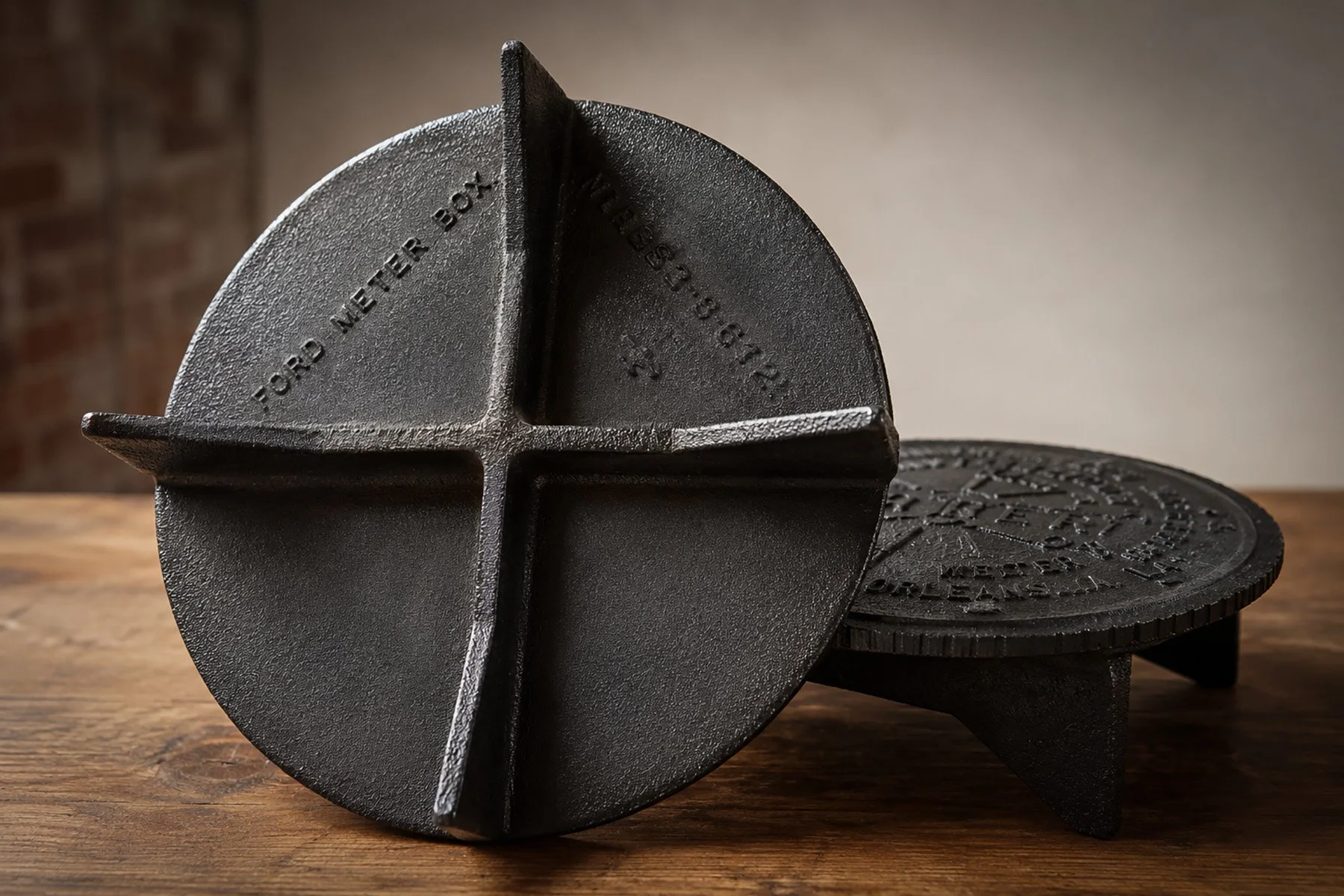
My Crescent Box cover began as a reminder of home. Nearly fifteen years later, it became the starting point for this story.
Looking down
When I bought my Crescent Box cover fifteen years ago, I didn't buy it because it had become fashionable or because it had started appearing on T-shirts, jewelry and artwork. I bought it for the same reason I've acquired so many other pieces over the years: it reminded me of growing up in and around New Orleans. Every time I saw one set into a sidewalk, I recognized it immediately. Owning one simply felt like preserving a small piece of the city.
For years, that's all it was—a well executed design and a conversation starter. Only recently did I begin asking the questions that eventually led to this story. The biggest surprise wasn't the design on top. It was what I found underneath.
If you ever have the chance to hold one of these covers in your hands, you’ll immediately feel its weight. I’m not talking about a novelty item from a French Quarter gift shop. I mean an authentic cast-iron cover, built in the same form that has served New Orleans for more than a century.
Turn it over and the underside reveals an entirely different kind of craftsmanship. Heavy reinforcing ribs extend across the casting, distributing weight and helping the cover withstand decades of traffic, shifting sidewalks and the constant demands of city life. Suddenly, the Crescent Box makes perfect sense. Its two sides solve two different problems. The top communicates with people, immediately identifying the object and connecting it to New Orleans. The underside communicates with physics, providing the strength and stability expected of infrastructure built to serve a city for generations.
That may be what impressed me most. Not simply that someone created an attractive water meter cover, but that every part of it served a purpose. The engineering and the aesthetics weren't competing priorities. They were complementary solutions.
Today, my water meter cover still waits for the right place in my collection. At nearly eleven pounds, it's not something you casually hang on a wall, and perhaps that's appropriate. Unlike many of the pieces I write about, it was never intended to be displayed. It was designed to disappear into the sidewalk, quietly doing its job while thousands of people walked across it every day without a second thought.
But somewhere along the way, that ordinary piece of municipal infrastructure became something extraordinary. Edwin Ford set out to solve an engineering problem for the New Orleans Sewerage & Water Board. More than a century later, his solution has become one of New Orleans' most recognizable visual symbols, embraced by artists, businesses and generations of residents who found meaning in an object most cities would have treated as purely functional. The most interesting stories aren't always waiting behind museum glass. Sometimes they're already part of the places we know best, quietly waiting for us to finally look down.